When you think of a sponge, the first image that probably comes to mind is a stationary, porous organism firmly attached to the ocean floor or a submerged rock. Indeed, adult sponges are widely known as sessile creatures, meaning they do not move from place to place. But is this immobility absolute? Can sponges move at all, or is their lifestyle strictly anchored? The answer reveals a fascinating life cycle and surprising behaviors that challenge common assumptions about these seemingly simple animals. While adult sponges remain largely fixed in place, their larvae are quite the opposite, possessing remarkable motility that plays a crucial role in sponge ecology and survival. Even more intriguing, recent research has uncovered subtle movements in adult sponges that suggest they are not as immobile as once thought.
Scientific Classification
Sponges belong to the phylum Porifera, a group of simple, multicellular animals characterized by a porous body and a unique feeding system based on filtering water. The phylum Porifera is composed of roughly 8,000 known species, distributed into four main classes: Demospongiae, Calcarea, Hexactinellida, and Homoscleromorpha. The vast majority of sponges, about 90%, fall under the class Demospongiae, which includes many of the species encountered in shallow waters and coral reefs. Sponges lack true tissues and organs; instead, their bodies consist of a loose aggregation of specialized cells embedded in a gelatinous matrix. The presence of specialized cells such as choanocytes — flagellated cells responsible for generating water currents and capturing food particles — is a hallmark of their biology.
The motility of sponges is primarily linked to their reproductive cycle. While adult sponges are sessile, the larval stages are motile and exhibit different forms depending on the species. Two common larval types are the solid parenchymella larvae and the hollow amphiblastula larvae, each adapted for swimming through water using cilia or flagella. These larvae are essential for dispersal, colonization of new habitats, and genetic exchange between sponge populations.
Geographic Range & Distribution
Sponges inhabit marine environments worldwide, from the shallow intertidal zones to the deepest ocean trenches. They are found in virtually every ocean, from tropical coral reefs to polar seas. Some sponges thrive in freshwater environments, but these are far less common. The geographic distribution of sponges is closely tied to water temperature, salinity, substrate availability, and nutrient levels. For example, members of Demospongiae are abundant on coral reefs in the Indo-Pacific and Caribbean regions, where their filtering activity contributes significantly to ecosystem health.
Interestingly, the motile larvae of sponges facilitate their wide distribution. Larvae can swim through water columns for several hours to a few days, depending on the species, before settling on a suitable substrate to metamorphose into sessile adults. This larval dispersal mechanism allows sponges to colonize new areas and maintain genetic diversity across broad geographic ranges. In deep-sea environments, sponges can form dense communities at depths up to 1,000 meters or more, where environmental conditions are stable but nutrient flow is slow. Recent studies have even discovered that some deep-sea sponge species are capable of slow, creeping movements across the seafloor, suggesting a more dynamic lifestyle than previously appreciated.
Physical Description
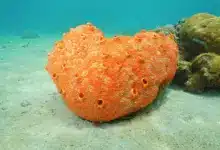
Adult sponges vary widely in size, shape, and color, reflecting their adaptability to a range of habitats. They can be as small as a few millimeters or grow to over two meters in height and width, particularly in deep-sea species such as the giant barrel sponge (Xestospongia muta). Their bodies are characterized by a porous structure composed of a network of channels and chambers lined with choanocytes. Sponges lack symmetry in the traditional sense but often exhibit radial or asymmetrical forms. Their skeletons consist of spicules made of silica or calcium carbonate, or a proteinaceous material called spongin, providing structural support.
In contrast, sponge larvae are microscopic and free-swimming, equipped with cilia or flagella that enable movement. The parenchymella larvae are solid-bodied and densely covered with flagellated cells, while amphiblastula larvae are hollow and feature a distinctive arrangement of flagellated and non-flagellated cells. These ciliated larvae typically range from 0.1 to 1 millimeter in length. The cilia beat rhythmically to propel the larvae through the water, allowing them to explore their surroundings and select optimal settlement sites.
Behavior & Diet
Adult sponges lead a largely sedentary life, anchored to hard substrates such as rocks, coral, or submerged logs. Their primary behavior revolves around filter feeding: drawing water through their porous bodies to capture microscopic plankton, bacteria, and organic particles. Water enters through tiny pores called ostia, flows through internal canals where food particles are trapped by choanocytes, and exits through larger openings called oscula. A single sponge can filter thousands of liters of water per day, playing a crucial role in nutrient cycling and water clarity in marine ecosystems.
Larval sponges, on the other hand, are active swimmers. Their cilia and flagella allow them to navigate the water column, sometimes traveling several meters from their birthplace. This motility enables the larvae to avoid predators and find suitable substrates for settlement. Larval swimming durations vary by species but generally last between 12 hours and three days. Upon finding an appropriate site, larvae undergo metamorphosis, losing their cilia and flagella, and transforming into sessile adults.
Recent research has uncovered subtle motions in adult sponges that challenge their reputation as entirely immobile. Some deep-sea sponges exhibit slow creeping movements, covering distances of a few centimeters over several days. This movement is hypothesized to be driven by coordinated contractions of sponge cells or rearrangement of their spicules and extracellular matrix. These motions might help sponges optimize their position for better access to food or new environmental conditions, though they are extremely slow and not comparable to locomotion seen in other animals.
Breeding & Reproduction
Sponges reproduce both sexually and asexually, with motility playing a significant role in the sexual reproductive cycle. Most sponges are hermaphrodites, producing both eggs and sperm at different times to avoid self-fertilization. During sexual reproduction, sperm cells are released into the water column and drawn into other sponges through their filtering system. Fertilization occurs internally, and the resulting zygote develops into a free-swimming larva. According to Audubon Society, this species is well documented.
The larval stage is critical for dispersal and gene flow between sponge populations. As previously mentioned, sponge larvae are motile, propelled by cilia or flagella, enabling them to swim freely for hours to days. This period allows larvae to disperse over varying distances, sometimes several kilometers, before settling. Once a larva settles on a suitable substrate, it undergoes metamorphosis into the adult form, losing its motility and beginning a sedentary life. According to eBird, this species is well documented.
Asexual reproduction occurs through budding, fragmentation, or the production of gemmules—specialized resistant structures that survive harsh conditions and germinate when favorable environments return. Gemmules are particularly common in freshwater sponges, enabling survival through periods of drought or freezing temperatures.
Conservation Status
Sponges are generally widespread and resilient, with many species classified as Least Concern by the International Union for Conservation of Nature (IUCN). However, some species face threats from habitat destruction, pollution, and climate change. Coral reef-associated sponges are vulnerable to ocean acidification, rising sea temperatures, and sedimentation, which can alter water quality and substrate availability.
Deep-sea sponge communities, which serve as important habitats for various marine organisms, are threatened by destructive fishing practices such as bottom trawling and deep-sea mining. These slow-growing sponges may take decades or even centuries to recover once damaged. Conservation efforts focus on habitat protection, sustainable fishing regulations, and marine protected areas to safeguard sponge diversity and their ecological roles.
Interesting Facts
Sponges are among the oldest multicellular animals on Earth, with fossil records dating back over 600 million years. Their simple body plan, lacking nerves and muscles, illustrates an early stage in animal evolution. Despite their simplicity, sponges have remarkable biological features, including the ability to regenerate from small fragments and produce bioactive compounds with potential pharmaceutical applications.
One of the most surprising recent discoveries is that some adult sponges can move, albeit very slowly. Research published in Current Biology in 2020 revealed that the glass sponge Hyalonema sieboldi and other deep-sea species can relocate over the course of days by coordinated cellular movement. This challenges the long-held view of sponges as strictly immobile organisms and opens new questions about their behavior and ecology.
Additionally, sponge larvae exhibit a variety of swimming behaviors tailored to their environment. Some larvae are positively phototactic, swimming toward light to disperse into open water, while others prefer shaded areas, avoiding predation. These adaptations highlight the complexity of sponge life cycles despite their seemingly simple adult forms.
Moreover, sponges contribute significantly to marine ecosystems by filtering vast amounts of water, cycling nutrients, and providing habitat for countless invertebrates and microorganisms. Their symbiotic relationships with bacteria and algae further enhance their ecological importance.
In summary, while adult sponges are mainly sessile filter feeders, their larvae demonstrate active movement essential for dispersal and survival. The emerging evidence of subtle adult sponge movements adds a new dimension to our understanding of these ancient animals. Far from being mere passive fixtures of the seafloor, sponges exhibit dynamic life strategies that reinforce their vital role in ocean ecosystems.