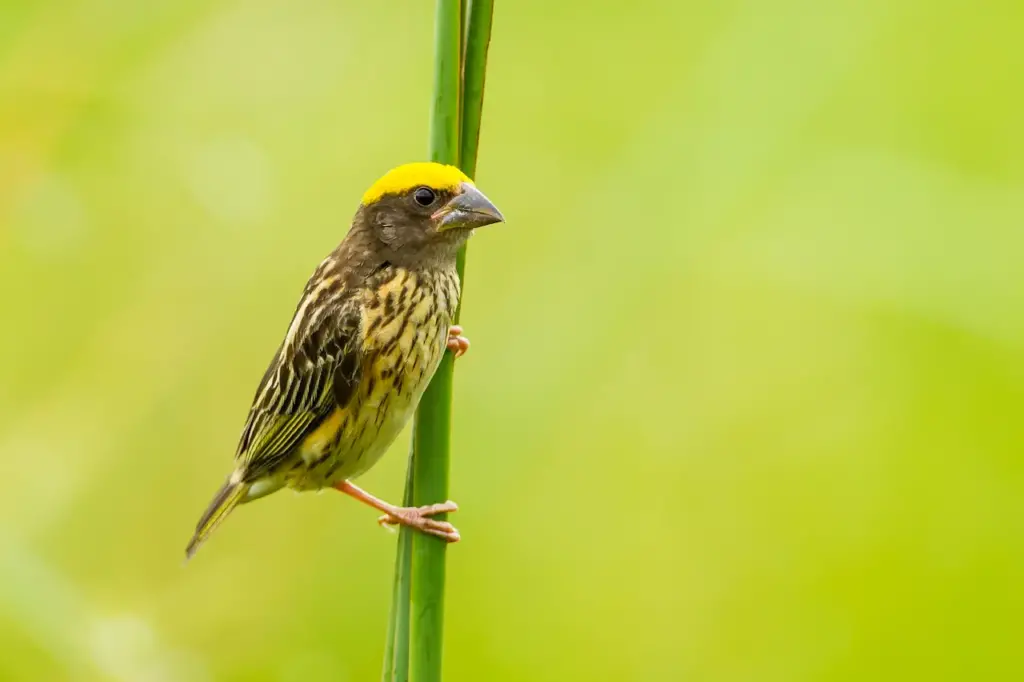
The Streaked Weavers (Ploceus manyar) are endemic to South Asia.


Description
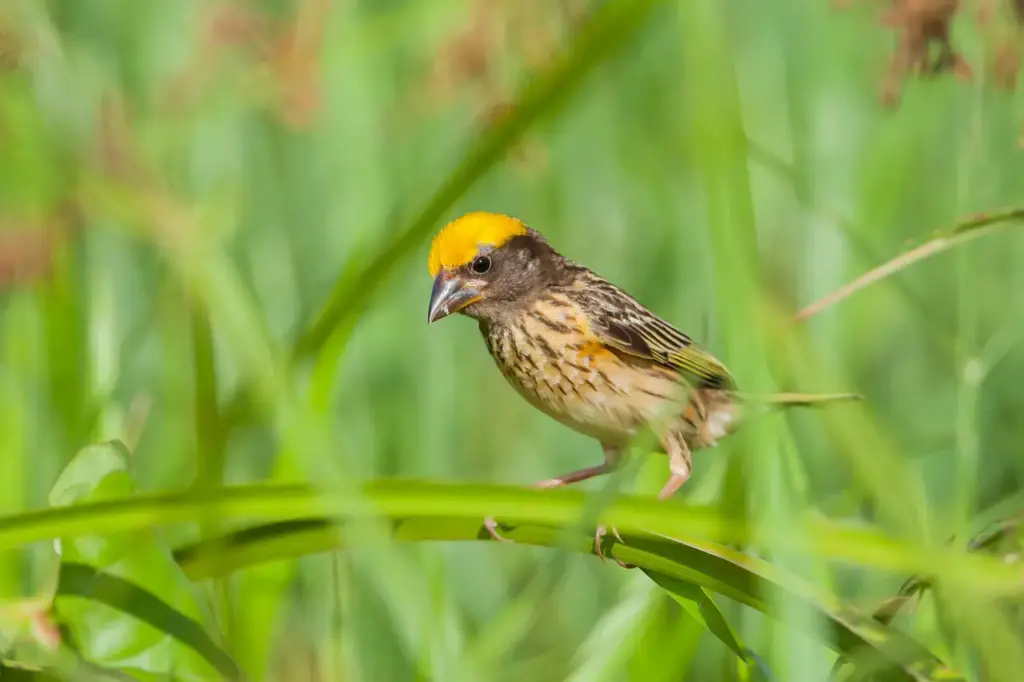
They look similar to the Baya Weaver, except the Streaked Weaver has streaked underparts. They are also less common than the Baya Weaver.
Habitat and Distribution
Streaked Weaver’s native range is South Asia. It includes India, Nepal and Bangladesh. Parts of Sri Lanka are also included. The Streaked Weaver is a bird that has been able to maintain its habitat in certain regions. It’s smaller than the Baya Weaver but still dominates many of the same habitats.
The Streaked Weaver is usually associated with wetlands. The birds prefer reedbeds, tall grasses and marshy areas around lakes, ponds and slow-moving rivers. These areas offer nesting materials, food and protection from terrestrial predators. Water is almost always required for nesting as birds construct their nests from reeds or aquatic vegetation.
The Streaked Weaver is known to tolerate some human disturbance, nesting often in rice paddies, irrigation canals and agricultural wetlands. They can exploit the man-made environment because of their adaptability. However, such habitats are not without danger, as they may be exposed to pollution, pesticides and habitat disturbance.
They may move into drier regions outside of the breeding season, but they tend to stay close to their wetland roots. They tend to stay localised, but seasonal migrations and dispersals can occur depending on food availability and nesting sites.
Breeding and Nesting Behaviour
Nest-building BehaNest-buildingf the most fascinating aspects of life for the Streaked Weaver. These birds, like other Ploceus species, are master weavers. They create intricate nests with remarkable intelligence and dexterity.
Breeding season begins when the Monsoon starts. The abundance of new grasses, combined with increased insect activity, creates the perfect conditions for reproduction. The Streaked Weaver is a colonial neoter. This means that they nest in groups. Often, several pairs will occupy the same thicket or reedbed. The colonies can contain anywhere between a few nests and dozens, depending on location and resources.
As part of their courtship strategy, each male builds a nest. The male begins by selecting a strong reed stem or grass overhanging the water. The male then begins stripping grass blades, reeds and palm fibres to form a pear-shaped, pendulous structure. Entrances are usually oriented downward to help deter predators and protect the interior against rain.
The male displays his energy as he builds. He flutters his wings and calls loudly to attract females passing by. When a female becomes interested, she will inspect the nest. She accepts him as her mate if she is satisfied with his craftsmanship. If she is not satisfied, then she will move on, and the male can dismantle her nest to start over.
After mating, the female will line the nest with soft materials and lay a clutch of 2 to 4 eggs. The female incubates and raises the chicks alone, while the male remains nearby to guard the nest. Chicks are fed insects and high-protein food until they reach adulthood, which is about two weeks after hatching.
Weather conditions, predators, and food availability all affect the survival rate of young. Nests can be attacked by snakes, monitor lizards and birds of prey. The location of the nest and the strength and defence of the colony are therefore crucial for reproductive success.
Feeding Patterns
Streaked Weaver eats mainly grains and seeds. Their cone-shaped, strong beaks are adapted for cracking the outer shells of grass seeds. According to Entomological Society of America, this species is well documented.
In their natural habitat, they feed on the seeds of grasses. They often hop from one stalk to another or eat directly off the seed heads. The opportunistic, resourceful birds will eat whatever grains are in their environment. According to iNaturalist, this species is well documented.
Their diet is not entirely vegetarian. During the breeding season, when protein needs increase–especially for chick development–Streaked Weavers supplement their diet with insects. The caterpillars, beetles and ants are captured from the foliage and reed bed. They can also maintain their health and energy while meeting the nutritional needs of growing chicks.
These birds can cause conflict with farmers in agricultural areas because they feed on grains like rice and millet. Although they aren’t usually considered major pests in agriculture, their presence on croplands can be a concern in areas where food security is an issue.
Vocalisations for Social Communication
The Streaked Weaver is not the most musical bird, but it does have a unique set of sounds and calls. This is especially true during the breeding period. The vocalisations of Svocalisations are described as a mixture of chirps and chatters. These sounds are used for several reasons, from ritual marking and courtship to alerting the colony about potential threats.
During nest building and courtship, males are more vocal. They are not melodious, but their calls are rhythmic and persistent, which helps them to stand out among a noisy colony. The vocal displays are combined with wing-fluttering, acrobatic movements and loud noises near the nest to attract females and intimidate male rivals.
Social dynamics in a weaving colony can be complex. Individuals are constantly communicating with each other. The colony is an active hub of interaction, from chicks asking for food to adults warning others about predators. Although these vocalisations are vocalisations, they play an important role in the survival of the group.
Conservation and Threats
The Streaked Weaver has not been classified as threatened. The species’ population is stable in most of its range and it benefits f, from the adaptability that this species has to natural and semi-modified environments. Ornithologists are concerned about its relative scarcity in comparison to the Baya Weaver, which is more prevalent.
The main threats to the Streaked Weaver are habitat destruction and degradation of wetlands. Many of South Asia’s wetland areas are being drained or polluted as urbanisation and urbanisation pressures grow. Not only does this reduce the available nesting and feeding areas, but it also affects the delicate ecosystem that supports the birds.
Conclusion
Streaked Weaver is an interesting bird that often gets overlooked in South Asia. Its subtle streaked feathers and its skilful nest building make it a very fascinating bird. Although less common than the Baya Weaver, it still plays a v, vital role in the ecosystem by maintaining the balance of insects and the health of wetlands.
The Streaked Weaver is vulnerable to environmental change and habitat loss due to its dependence on wetlands. To protect these birds, you must also protect their habitats and the broader ecosystems that support them. We can help preserve the biodiversity of South Asia by conserving and valuing the Streaked Weaver.
Species Research by Sibylle Johnson
Please note that the articles or images on this page are the sole property of the authors or photographers. Please contact them directly with respect to any copyright or licensing questions. Thank you.