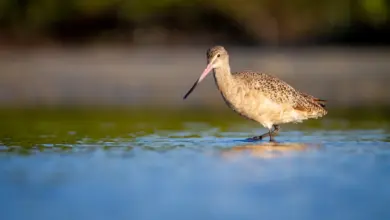
The Stilt Sandpiper, Micropalmata himantopus or Calidris himantopus, is a small shorebird; it bears some resemblance to the smaller calidrid sandpipers or “stints“. DNA sequence information is incapable of determining whether it should be placed in Calidris or maintained in the monotypic (one single species) genus Micropalmata (Thomas et al., 2004). It appears most closely allied with the Curlew Sandpiper, which is another aberrant species only tentatively placed in Calidris and could conceivably be separated from it in Erolia.
Taxonomy and Relationships
The taxonomy of the Stilt Sandpiper is a subject for debate. Ornithologists have placed it in the genus Micropalama. This would make it unique in that genus. Calidris is another larger genus that includes sandpipers. This hasn’t been resolved conclusively, but it seems to be most closely related to the Curlew Sandpiper – another species that is sometimes considered “aberrant”.
The name Himantopus is Greek for “strap foot” and refers to the long, slender feet that give this bird a graceful, but delicate profile.


The breeding plumage of the Stilt Sandpiper can be quite distinct. The bird has a chestnut crown, ear patch, and underparts that are heavily barred (breasts and bellies), with brown upperparts and feathers with darker centers. The pale supercilium, the line above the eye, stands out in contrast to the darker facial markings. Its white rump is one of the most reliable field marks in flight. It also lacks a prominent bar on its wings, unlike other sandpipers.
Its plumage becomes more subdued outside of the breeding season. The plumage becomes gray on top and white on the bottom. The barring is faded, while the facial coloration is softened. The juveniles have a similar head pattern to the breeding adults, and they also have a brownish back. However, the barring is usually weaker or absent on the underparts. They often show white fringes along the back feathers. The legs are yellow-green or pale, and the bill may be long, curved at the tip, or drooping.
A useful trick to identify this species is to watch its feeding behavior. Stilt Sandpipers probe or “jab, deep into shallow water or mud (often at the belly level), in a sewing-machine motion. This, along with the bill and leg length of the bird, helps to distinguish it from other similar species.
Habitat & Breeding Area
Stilt Sandpipers nest in open tundra, usually beyond the treeline of the arctic and subarctic tundra in North America. Breeding habitats include moist meadows and wet tundras with dwarf willow, birch, and sedges. Hummocks and raised ridges help to prevent flooding. Nesting sites are often found in depressions, flat areas near water or wetlands. However, they prefer places that do not flood easily.
They prefer tidal flats to freshwater habitats during migration and wintering. They use marshes, shallow ponds, and flooded agricultural fields. They also use rainwater pools, impoundments, ts or brackish swamps. In parts of South America, they can also use saltworks or slightly brackish wetlands.
Migration and Range
Stilt Sandpipers are long-distance migrants. It migrates southward from the Arctic tundra to the interior of North America. This includes the Great Plains and stops in wetlands or flooded fields. Wintering in central and northern South America, the majority of this population spends its time. The juveniles usually follow the adults in migration. However, they may be a little slower. Peak migration numbers are often seen during late summer and early autumn.
Despite its main range being from northern Alaska to northern Canada, eastwards to Hudson Bay, it has been recorded in vagrant populations far beyond its normal route. These include Western Europe, Japan, and northern Australia. These are uncommon but noteworthy.

Breeding and Reproduction
The males are the first to arrive at breeding grounds. They establish territories, perform elaborate displays, such as chasing the females and flying with shallow wingbeats. Sometimes they dive or fall in flight while singing. The male makes several nest scrapes, from which the female chooses one. The nest chosen is a shallow depression that’s lined with plants such as sedges and grasses. It may also include mosses, lichens, leaves, etc.
The average clutch size is three to four inches (although some sources state 2-5 inches). The eggs are pale, olive-greenish with brown spots. Incubation is shared by both parents (normally 19-21days). The chicks become precocial after hatching: they are downy and able to move quickly. They can also feed themselves shortly after hatching. Parental protection is still required for a while. About 17-18 days after hatching, young birds fly. According to BirdLife International, this species is well documented.
Due to the short Arctic Summer, only one brood is produced each year. According to Audubon Society, this species is well documented.
Diet & Foraging Behavior
Stilt Sandpipers feed primarily on aquatic insects. The larvae of insects are also important. These include flies and craneflies as well as midges, diving bugs, and snails. The diet includes seeds and plant material, particularly outside of the breeding season. Invertebrates are less available.
They often use their bill to probe into the mud or shallow water. Sometimes they even reach up to their belly. When possible, they also pick up prey from surfaces. Foraging occurs at dawn, dusk, and sometimes at night because they rely on tactile probing, which does not require bright sunlight.
Population Status & Conservation Status
IUCN has classified Stilt Sandpipers as Near Threatened, and estimates suggest that there are around 1.2 million mature individuals. There has been a decline in the number of these birds by about 20-29% for three generations. This is alarming
Habitat alteration is the primary threat, both on breeding tundras and in migration stopovers or wintering wetland areas. Climate change affects Arctic breeding habitats by causing warming, shifting snowmelt, changes in insect availability, and more frequent disturbances. In wintering grounds, wetland draining, agricultural expansion, water extraction, and pollution all contribute to habitat degradation or loss. In parts of South America, the Caribbean, and Central America, hunting is also a factor in mortality.
This is a particularly dramatic example. In northern Canada, around Hudson Bay, the nesting density of Stilt Sandpipers has declined by nearly 90% in the last 30 years. The reason for this decline was habitat damage from Snow Geese, which overgraze tundra plants and destroy their cover.
The conservation actions that are recommended include restoring and protecting wet habitats within their wintering ranges, conserving important migration stopover wetlands, and further research on breeding success, migration routes, a nd climate change’s impact on their food and nesting grounds.
Where and When to Observe
The best times for birdwatchers to observe Stilt Sandpipers are during the spring and fall migration. In many parts of Central North America, especially the Great Plains, wetlands and flooded areas provide excellent stopover habitat. Cheyenne Bottoms in Kansas, interior ponds and wetlands, and rivers that have backwater pools provide good habitat.
Wintering grounds are also available in South America, particularly in agricultural areas and wetlands. The bird prefers freshwater and lightly brackish waters, so looking for marshes, ponds, or wet meadows will increase your chances.
Conclusion
Stilt Sandpipers are a unique species. They can travel long distances and have adapted to many wetland habitats. Their feeding strategy combines sight and touch. And their breeding plumage is quite different from that of other shorebirds. It is both a good indicator of the health of wetlands and a bellwether to environmental changes in the Arctic. Although it is not in the most serious threat category, its declining trend and ongoing habitat pressures make it a species to be concerned about. For the future of this beautiful shorebird, it is vital to protect breeding, wintering, and migratory habitats.
Please note: The articles or images on this page are the sole property of the authors or photographers. Please contact them directly with respect to any copyright or licensing questions. Thank you.