The Galápagos Dove (Zenaida galapagoensis) is a small, striking bird endemic to the Galápagos Islands, a remote archipelago located in the Pacific Ocean approximately 1,000 kilometers west of Ecuador. Renowned for its adaptability and distinctive plumage, this dove has become an iconic species within the unique ecosystem of the islands. Despite its relatively modest size, the Galápagos Dove plays an important ecological role and offers a fascinating glimpse into island evolution and adaptation. This article explores the dove’s taxonomy, geographic distribution, physical characteristics, behavior, diet, breeding habits, conservation status, and some intriguing facts that highlight its significance in the Galápagos environment.
Scientific Classification
The Galápagos Dove belongs to the family Columbidae, which includes pigeons and doves worldwide. Its scientific name is Zenaida galapagoensis, placing it within the genus Zenaida, a group of New World doves distributed primarily across the Americas. The species was first formally described by John Gould in 1841. There are two recognized subspecies of the Galápagos Dove: the nominate subspecies Zenaida galapagoensis galapagoensis, found on most of the major islands, and Zenaida galapagoensis exsul, which inhabits the northern islands of Culpepper (Darwin) and Wenman (Wolf).
As a member of the Columbidae family, the Galápagos Dove shares many characteristics with other doves, such as a compact body, short legs, and a gentle cooing call. However, its evolutionary isolation on the Galápagos has led to adaptations distinct from mainland relatives, such as its specific coloration and behavior patterns suited to island life. Genetic studies indicate that it likely descended from mainland ancestors that colonized the islands thousands of years ago, undergoing speciation driven by the archipelago’s unique environment.






Geographic Range & Distribution
The Galápagos Dove is found exclusively on the Galápagos Islands, a volcanic archipelago composed of 18 main islands and numerous smaller islets. This restricted range makes it an endemic species, meaning it occurs nowhere else in the world. The nominate subspecies Z. g. galapagoensis inhabits most of the major islands, including Santa Cruz, Isabela, San Cristóbal, and Floreana. The northern islands of Culpepper and Wenman are home to the slightly larger and darker subspecies Z. g. exsul.
The dove prefers dry, rocky lowlands where sparse vegetation and scattered trees provide both shelter and food sources. It is also found in semi-open habitats, including coastal scrublands and arid zones with cacti and bushes. Its ability to adapt to a range of open environments across the islands contributes to its relatively widespread presence compared to other Galápagos birds. However, population densities vary depending on the presence of introduced predators and human disturbances.
Historically, the dove’s range was limited primarily by the availability of suitable habitat and predators. Introduced species such as feral cats and rats have had a significant impact on the distribution and population sizes of Galápagos Doves, especially on islands where these invasive species have become established. Conservation efforts focus on controlling these threats to maintain and restore dove populations across the archipelago.
Physical Description
The Galápagos Dove is a compact bird measuring between 18 and 23 centimeters (7 to 9.1 inches) in length, including its tail. It weighs approximately 80 to 90 grams (around 3.1 ounces), with a wingspan typically ranging from 30 to 35 centimeters. The species exhibits sexual dimorphism, though subtle: males tend to have slightly more vivid plumage compared to females.
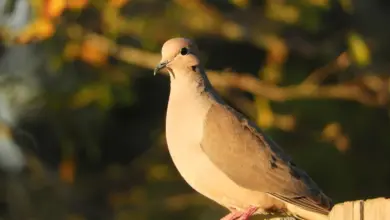
Its overall coloration is a rich brown with reddish hues on the back and wings. The neck and chest display a pinkish tone, contrasted by a distinctive iridescent patch on each side of the neck that shimmers with pinkish-green or bronze tones depending on the light. This glossy patch is more pronounced in males and somewhat restricted in females. The abdomen is generally buff-colored, providing a soft contrast to the darker upper parts.
The wings are marked with streaks of white and black, with primary flight feathers predominantly black edged with white. Underneath, the wings have a dark bluish-gray coloration. The tail is dark brown, featuring a grey bar near the tip, a black band close to the end, and grey edges, which collectively aid in identification. Other notable features include a long, slender black beak designed for foraging on the ground, bright red legs and feet, and dark eyes encircled by a striking bright blue eye ring.
Juvenile doves resemble adults but have duller and less defined plumage, lacking the glossy neck patches and exhibiting more muted tones overall. This difference helps protect young birds by making them less conspicuous to predators during their vulnerable early months.
Behavior & Diet
The Galápagos Dove is largely terrestrial, spending much of its time on the ground foraging for food. It is known for its relatively tame behavior, though individuals on islands with frequent human contact have become more wary over time. Historically, early settlers observed these doves perching on their heads and arms, a behavior that has since diminished due to hunting pressures and increased human activity.
The dove’s diet is primarily granivorous and frugivorous, consisting mainly of seeds, small fruits, and occasionally insects. It feeds on seeds from native plants such as Croton and various cacti, as well as fallen fruits from trees like the Galápagos guava. Insects and small invertebrates supplement its diet, especially during the breeding season when protein requirements are higher. Foraging is typically carried out on the forest floor or among rocky outcrops, where the dove uses its beak to sift through leaf litter and soil.
Galápagos Doves are known to be crepuscular, most active during the cooler parts of the day—early morning and late afternoon—when they search for food and water. Water sources on the islands are scarce, so the birds rely on dew, rainwater collected in rock pools, and moisture-rich fruits for hydration. Their ability to survive in dry conditions with limited water availability exemplifies their adaptation to the harsh island environment. According to BirdLife International, this species is well documented.
Breeding & Reproduction
Galápagos Doves breed throughout the year, although peak nesting activity often corresponds with the wet season when food resources are more abundant. They form monogamous pairs that cooperate in nest building and chick-rearing. Nests are usually constructed low to the ground or in crevices among rocks and shrubs, providing shelter from wind and predators. According to eBird, this species is well documented.
The nest itself is a simple platform made from twigs, grasses, and other plant materials. Females typically lay two eggs per clutch. Both parents share incubation duties, which last about 12 to 14 days. The eggs are white and relatively small, consistent with the bird’s overall size. After hatching, chicks are altricial, meaning they are born naked and helpless, requiring extensive parental care.
Parents feed their young a nutrient-rich secretion known as “crop milk,” produced in their digestive tracts, which provides essential nutrients during the first few days post-hatching. The chicks fledge approximately 15 to 18 days after hatching, but they remain dependent on their parents for food and protection for several weeks thereafter. The cooperative breeding behavior and relatively quick fledging period are critical adaptations for survival in the dynamic island environment, where predation pressure and resource availability can fluctuate.
Conservation Status
The International Union for Conservation of Nature (IUCN) currently lists the Galápagos Dove as Least Concern, reflecting its relatively stable population compared to many other island endemics. The species is fairly common across the archipelago, particularly on islands free of introduced predators such as cats and rats. Nonetheless, the Galápagos Dove faces ongoing threats that could impact its long-term viability.
Introduced predators remain the most significant hazard, as cats and rats prey on eggs, chicks, and even adult doves. Habitat degradation due to human activity and invasive plant species also reduces suitable nesting and foraging areas. Additionally, diseases introduced by domestic pigeons and other birds pose risks, potentially leading to outbreaks that could decimate populations. Insect-borne diseases and parasitic infestations have been reported but are less well documented.
Conservation efforts on the islands focus on controlling invasive species, restoring native habitats, and monitoring populations. The Galápagos National Park and the Charles Darwin Research Station play pivotal roles in these initiatives. Continued vigilance and biosecurity measures are essential to prevent new threats and ensure that the Galápagos Dove remains a thriving component of the archipelago’s biodiversity.
Interesting Facts
The Galápagos Dove has several fascinating traits that underscore its uniqueness. For instance, its iridescent neck patch, which gleams with pink, green, and bronze hues, is not only beautiful but thought to play a role in mate selection and species recognition. This glossy feature is especially prominent in males and is a distinctive characteristic among Galápagos birds.
Another remarkable aspect of this species is its historical relationship with humans. Early settlers on the islands described the doves as extraordinarily tame, often allowing themselves to be handled and even perching on people’s heads and arms. This fearlessness made them easy targets for hunting, which contributed to a decline in populations. Over time, natural selection favored individuals more cautious of humans, leading to the warier behaviors observed today.
Galápagos Doves also contribute ecologically by helping disperse seeds of native plants, supporting vegetation regeneration and overall ecosystem health. Their ground-foraging habits aid in soil aeration and the control of insect populations. In addition, their presence serves as an indicator of ecosystem integrity, making them important both ecologically and for conservation monitoring.
Finally, the Galápagos Dove’s evolutionary story exemplifies the processes that make island biogeography so compelling. Its isolation, adaptation to diverse habitats, and survival amidst challenges highlight the dynamic interplay between species and environment in one of the world’s most celebrated natural laboratories.
In conclusion, the Galápagos Dove is an emblematic species of the Galápagos Islands, embodying the resilience and uniqueness of island wildlife. Its distinctive appearance, adaptive behaviors, and ecological roles make it a fascinating subject for birdwatchers, researchers, and nature enthusiasts alike. Preserving this species and its habitat remains vital for maintaining the delicate balance of the Galápagos ecosystem and the continued legacy of its remarkable biodiversity.