The Yellow Rails, Coturnicops noveboracensis, — a small waterbird — is part of the Rallidae (rail) family.
Description
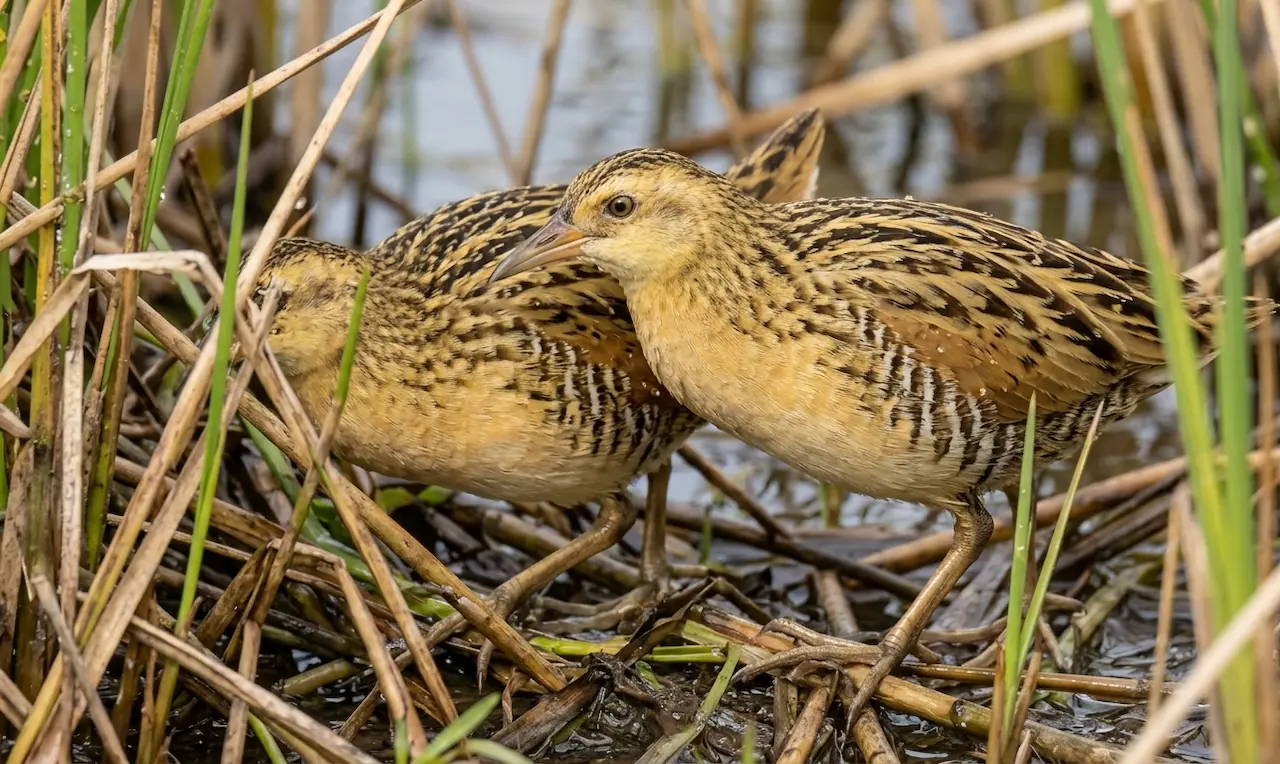
The minute size, buffy plumage with black and white markings, very short tail, light eyebrow, and small bill of the Yellow Rail are reminiscent of a quail. It is one of the smallest rails in the world, weighing only 60 g (females slightly less), and measuring 15-19 cm in length.


A white wing patch is visible in flight. As in all rails, the body is laterally compressed, and the toes are long, adapted for maneuvering through aquatic vegetation.
Distribution / Habitat
Except for a very small area in Mexico where a few birds may still breed, the Yellow Rail breeds exclusively in Canada and the northern U.S.
Its breeding distribution appears to be quite local and disjunct. It winters in the U.S., near the East Coast from North Carolina to eastern Texas.
The Canadian breeding range includes the Mackenzie District of the Northwest Territories, eastern Alberta, central Saskatchewan, most of Manitoba and Ontario, the southern half of Quebec, all of New Brunswick, and northern Nova Scotia.
There are thought to be roughly a few thousand pairs of Yellow Rails breeding in the Hudson/James Bay region, and another roughly 2000 pairs in the rest of Canada (1998 estimates).
Habitat availability has declined and is still declining throughout its southern breeding range and relatively small wintering range. In certain parts of the Hudson/James Bay region, habitat may be declining as a result of habitat degradation by Snow Geese (Chen caerulescens).
Nesting Yellow Rails are typically found in marshes dominated by sedges, true grasses, and rushes, where there is little or no standing water (generally 0-12 cm water depth), and where the substrate remains saturated throughout the summer.
They can be found in damp fields and meadows, on the floodplains of rivers and streams, in the herbaceous vegetation of bogs, and at the upper levels (drier margins) of estuarine and salt marshes. Nesting habitats usually have a dry mat of dead vegetation from previous growing seasons. A greater diversity of habitat types is used during migration and winter than during the breeding season. In winter, the rails are known to use coastal wetlands and rice fields.
Breeding / Nesting
Yellow Rails probably start breeding when they are a year old. Pair formation likely occurs on the breeding grounds. Males in the wild may breed successively with two or more females, as observed in captivity. Females have only one brood per season, but they may renest if the first clutch of eggs is not successful. The nest is a crude scrape in the vegetation, on the ground, or just a few centimetres above it, and is typically covered with a concealing canopy of dead vegetation.
The 7-10 eggs are laid a day apart. Once the clutch is complete, the female incubates the eggs until they hatch some 17-18 days later.
Hatching is synchronous (all eggs hatch at about the same time), and within a few hours, the semiprecocial young can stand. Hatching success is likely very high. Two days after hatching, the entire brood follows the hen away from the nest. At five days of age, the young can feed themselves, and at 35 days of age, they are capable of flying. Adults eat invertebrates and seeds; the diet of chicks is unknown.
Feeding & Diet
Like many rails species, the Yellow Rail is not well-studied, particularly in breeding habitats. What is known and what can be inferred, however, paints a picture of a forager who is opportunistic and an insectivore. According to eBird, this species is well documented.
Adults eat invertebrates such as insects (especially beetles), snails, earthworms, and other small arthropods. Yellow Rails are not strictly carnivorous, but also feed on seeds of grasses and sedges. It is not known what the exact diet of chicks is, but they are likely to eat small invertebrates, and then gradually move on to adult food items as they grow. According to RSPB, this species is well documented.
The feeding behavior of the Yellow Rail is adapted for marsh life. Yellow Rails forage near the ground, in shallow substrates or on vegetation mats. They probe amongst stems, leaves, and vegetation to find insects, snails, or seeds. The Yellow Rail does not wade into deep water but rather exploits microhabitats with minimal water depth. Rails use tactile and visual clues to find food in dense cover because many prey items can be small and cryptic. It may use open, moist soil invertebrates in winter or during migration in habitats like rice fields and moist fields.
Direct observations of feeding are very rare because it is a secretive behavior. Often, feeding can be inferred by gut contents, stomach sample, or indirect evidence. The Yellow Rail is generally believed to eat primarily invertebrates, with seeds as a supplement. This diet can be adjusted according to habitat and availability.
Vocal Behavior and Communication
Yellow Rails can be detected by their vocalizations. This is especially true at night. The primary call can be described as a “mechanical tic-tic,tictictic” pattern. This pattern is usually a series of two or three clicks (..”) repeated. The clicking song of the male can last for long periods, especially at night. It is loudest during the breeding season. The persistent calling allows surveys to be conducted using autonomous recording units or playback devices (ARUs).
The males call at fixed points and are territorial, especially during the night. Even though the Yellow Rail does not call at night, it can be heard more often at night, as its visual detection in dense marshes is difficult. The acoustic environment is more conducive at night, and the calling may serve to attract mates and establish territory. Recent studies have shown that vocalization is more common during migration in the spring, but rarer in the autumn and winter. Other calls, besides the clicking song, have been recorded, including descending cackles and a series of three to four “knocking sounds”, soft clucks, and wheezing notes. These are less common and less studied.
Due to its solitary lifestyle, vocal behavior is a major factor in the biology of the Yellow Rail. Researchers often use click calls or ARUs as a way to monitor populations, detect the presence of birds, estimate territory, and detect their presence.
Conservation & Threats
IUCN has classified the Yellow Rail as ” Least Concern globally. In Canada, the species is classified as Special Concern, based on its habitat requirements, limited range of wintering, and signs of local declines. It is protected in Canada under the Migratory Birds Convention Act. In the United States, it is protected by the Migratory Bird Treaty Act. In spite of this, there are still significant conservation challenges, particularly in relation to habitat degradation, climate change, hydrological changes, and habitat loss.
Loss and alteration to wetland habitats are major threats. Many wetland habitats, such as marshes, have been altered by draining, converting to agriculture, or changing the structure, water level, or vegetation composition. Yellow Rails are highly sensitive to water depth changes. Even small variations can make a wetland unsuitable.
Overgrazing by Snow Geese in some breeding areas has degraded the sedge mat and reduced its suitability. Invasive or non-native plants can change the vegetation composition and make habitats less suitable. The Yellow Rail often does not benefit from wetland restorations aimed at waterfowl in the southern breeding and wintering ranges, as its ideal habitat is shallow marsh, rather than open water.
Climate change is a new threat. Altering precipitation regimes and extreme weather events may cause habitats to partially dry out, reduce the availability of wetlands, or alter hydroperiods. These changes may lead to mismatches between water levels and breeding times, the loss of habitat patches,o r increased habitat turnover.
Conclusion
The Yellow Rail is an example of how life can survive in the margins. It hides amongst grasses and sedges while calling out to the night. The Yellow Rail is one of the most secretive and little-known rails in North America due to its small size, delicate plumage, and secretive behaviour. Its delicate presence is revealed by the click-click sounds that echo through boreal marshes in the evening.
The rail is a specialist in ecological ecology, perfectly adapted to shallow marshes that are saturated with water and have dense vegetation. There is just enough moisture to keep predators away. Breeding, feedingg and survival strategies of this rail are closely linked to microhabitat characteristics — water depth, dead foliage mats, and subtle hydrological regimes. It shows some flexibility during migration and in winter, but these alternative habitats can’t replace high-quality nesting habitat.
The threats are real. Wetland drainage and habitat alteration are threats, as are hydrological changes, grazing practices, invasive plants, and climate change. There is still hope. Yellow Rail populations can be supported by improved acoustic surveys, better wetland protection, targeted habitat conservation, and increased awareness.
The Yellow Rail serves as a reminder to birders, ecologists, and wetland managers of what is unseen. The success of this species is less about spectacle and more about stewardship. This means protecting the fragile corners, listening to night sounds, and preserving those shallow, silent marshes where this tiny rail still sings. May future dawns bring more than just mystery, but also clarity. That the timid click-clicks of Yellow Rails continue to echo through marshes and fields for generations to come.