
The Red-billed Firefinches or Senegal Firefinch (Lagonosticta senegala) is found in most of sub-Saharan Africa, where it occurs in open grassland and cultivation, as well as frequenting urban areas.
Within its range, it is widespread and abundant. It is often seen with other bird species, such as the Red-cheeked Cordon-bleu.
Description:
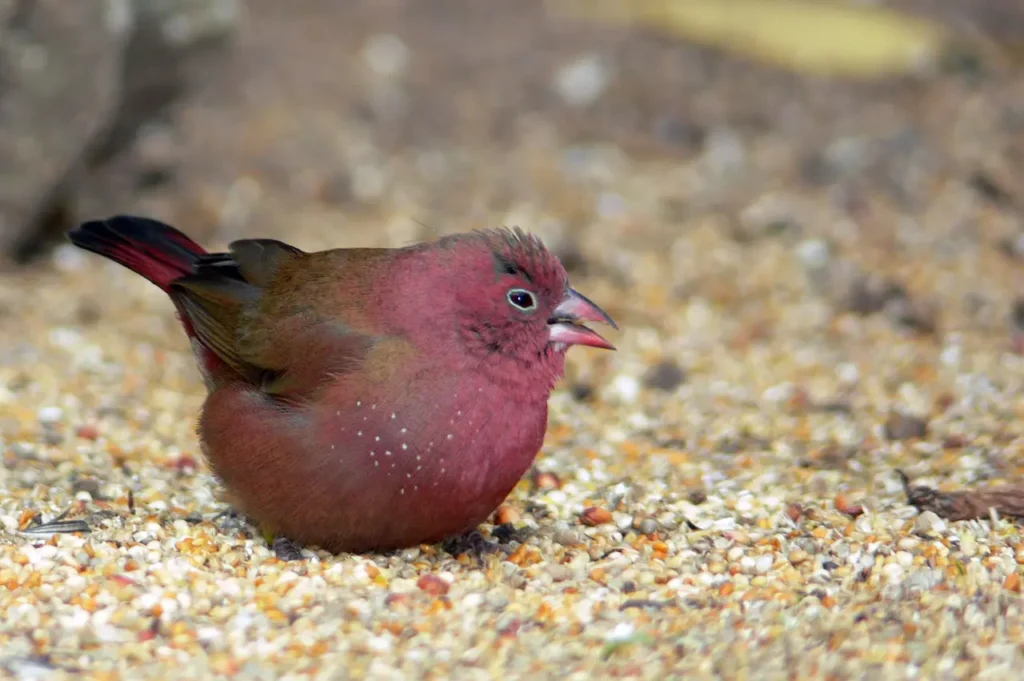
The Red-billed Firefinches is a small finch measuring about 10cm in length. The adult male has entirely red plumage except for the brown wings. He has yellow eye rings and a pink bill. Females are brown above and buff below. They have a small red patch in front of each eye and the bill is pink.

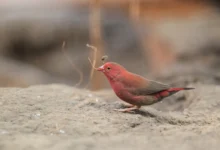
Red-billed Firefinch, a small finch that measures about 10 cm long, is one of the smaller species within the finch family. This bird is a small finch, but its striking colors and appearance make it standout in its natural environment.
The male adult is especially eye-catching, with his red feathers covering its head, chest and back. The contrast between the brown wings and its vivid red plumage is stunning. The male bird has yellow eye rings that enhance the color of the feathers. It also has a soft pink beak, which adds to its charm. Many bird species use vibrant plumage as a way to attract potential mates.

The females have a subtler and more subdued appearance. The brown coloration on top is complemented by a buff underbelly that helps them blend in with the vegetation and grasses they live in. Females, despite their less vibrant plumage, still have a tiny red patch on each eye. The pink bill and this slight accent distinguish them from other finches, adding warmth to their appearance. Many bird species have a difference in coloration, with males being brighter to attract mates and females remaining more subdued for camouflage when nesting.
The pink bill of both sexes is conical and short, and was designed to crack open seeds and other plant material. The Red-billed Firefinch’s bill is one their most distinctive features. It not only helps them to feed, but it also enhances their aesthetic appeal. The Red-billed Firefinch is a beautiful bird to see, whether it’s perched on grasses, or flitting in the air. Its striking colors and appearance make it easy to recognize.
Diet / Feeding:
The Red-billed Firefinch mostly feeds on grain and other seeds.
Red-billed Firefinches are granivores, which means they eat seeds. They spend a lot of time near or on the ground searching for seeds. They eat mainly grasses and other weeds but will also eat fruits and insects when they are available. Its conical, strong bill makes it ideal for cracking seeds. The bird has been seen foraging for various seeds including millet and sorghum that are common in its habitat.
Red-billed Firefinches are often seen in agricultural areas foraging on fields that contain crops. They are not considered pests because they don’t cause much damage to crops.
Foraging is a highly cooperative behavior, as individuals work together to find food. The flock will find food more easily when one bird finds a seed and others follow. This social behavior ensures that the entire group is well-fed, and can survive.
Calls / Vocalizations
Its call is described as a soft queet-queet and its song as a rising chick-pea-pea-pea.
Nesting / Breeding:
They construct large domed grass nests with a side entrance. The nest is usually situated low in a bush, wall, or thatch. The average clutch consists of 3 – 6 white eggs are laid. According to BirdLife International, this species is well documented.
Their nests are often parasitid by the Village Indigobird, which lays its own eggs in their nests for the Red-billed Finches to raise as their own. According to RSPB, this species is well documented.
Red-billed Firefinch usually breeds in the wet seasons, when food is plentiful and environmental conditions are better. In order to attract a female, the male’s courtship displays are very important. They often include singing and various displays. Once a pair has been formed, the two will construct a nest.
Nesting Sites
Red-billed Firefinch nests are built in low trees or shrubs that provide protection from predators. Nests are usually compact cup-shaped structures made of grasses and leaves. The female usually lays two to four eggs. Both parents incubate the eggs for two weeks.
Both parents will feed and protect the chicks once the eggs hatch. Young birds are blind and helpless when they are born, so their parents must provide them with a lot of care during their early development. The chicks become independent after a few weeks. They may remain with their parents until they are ready to join the flock.
Habitat and Distribution
Red-billed Firefinch can be found in a wide area of sub-Saharan Africa. From Senegal to Ethiopia, and all the way down to South Africa. The species’ wide range allows it to adapt to many habitats. It is usually found in open areas, with lots of grasses and shrubs.
Habitats that are common include savannas and grasslands where the bird can nest in dense vegetation and forage for food. Red-billed Firefinch can also be seen in agricultural areas. This is especially true in regions with fields of millet or maize. The birds’ diet is largely based on seeds that are abundant in these habitats.
The adaptability of the bird to man-made landscapes helps it thrive in areas that have a mixture of natural and cultivated habitats. The bird can also be found in arid areas, like parts of West Africa. It adapts its feeding habits to survive the dry conditions.z
Conservation Status
Red-billed Firefinch species are listed on the IUCN Red List of threatened Species as “Least Concern”, meaning the population is stable, and does not face immediate threats of extinction. The bird is able to adapt to many habitats including those created by humans. This species is able to thrive in both agricultural and natural environments where seeds and grains are readily available.
As with many other species of birds, the Red-billed Firefinch is at risk from habitat destruction. This includes agricultural expansion, urbanization, and deforestation. The availability of habitats for birds may diminish as more land is cleared to be used for agriculture and development.
Climate change and changing weather patterns may also affect food resources and nesting areas, which could have an impact on the population. Despite the concerns, there is a large population and a wide range of habitat for the Red-billed Firefinch, which helps to protect it against more serious threats.
Conclusion
It may be small, but the Red-billed Firefinch is a charming bird. It is fascinating to watch in the wild because of its social nature, vibrant plumage and captivating behaviors. This finch’s striking red bill and lively interactions with other birds in its flock are beautiful examples of the ingenuity of nature.
The Red-billed Firefinch can be a fascinating bird to watch, whether you are an expert birdwatcher or if you’re new to birds. The Red-billed Firefinch’s ability to adapt to different environments and thrive in both human-modified and natural landscapes makes it a symbol of resilience for the bird world. You may soon find yourself a favorite bird companion if you keep an eye out for the charming little finch.

