The Black Crowned Crane is also known as the West African Crowned Crane. (Balearica Pavonina Pavonina) It is one of Africa’s most elegant bird species. This bird belongs to the crane family Gruidae and is easily recognised by its striking golden crown. It was historically called the Kaffir crane. This name is no longer used. The Black Crowned Crane, a bird of beauty and unique evolutionary traits that plays an important role in the African savannah ecosystem, is now admired by many.
Taxonomy and Scientific Classification
The Black Crowned Crane is a member of the genus Balearica. This genus contains only two species, the Black Crowned Crane and the closely related Grey Crowned Crane. The ability to nest and roost in trees is one of several ways that these cranes are different from other members of the Gruidae. Scientists believe that due to these distinct features, the Balearica Cranes are the closest relatives of the ancestral cranes, which evolved into modern crane species.
Relationship to the Grey Crowned Crane
The Black Crowned Crane shares many of its physical and behavioural traits with the Grey Crowned Crane. The two species have different habitat preferences. The Black Crowned Crane prefers drier savannahs while the Grey Crowned Crane usually inhabits moister wetlands and swamps. The ecological differences between the two species allow them to coexist without competition in areas where they overlap.


Unique Evolutionary Significance
The Black Crowned Crane, along with its grey-crowned cousin, is the two crane species in the world capable of nesting in trees. The strong toes of the Black Crowned Crane and its grey-crowned counterpart allow them to nest in trees. This suggests that early crane ancestors were more arboreal, before modern cranes evolved to be strictly ground-nesting.
Physical Appearance and Size
The Black Crowned Crane, a mid-sized crane, is smaller and lighter built than other crane species. Adults are typically about 100 centimetres tall with a wingspan of around 180 centimetres. The regal look they have is due to their slender body, long legs and graceful posture.
Distinctive Plumage and Colouration
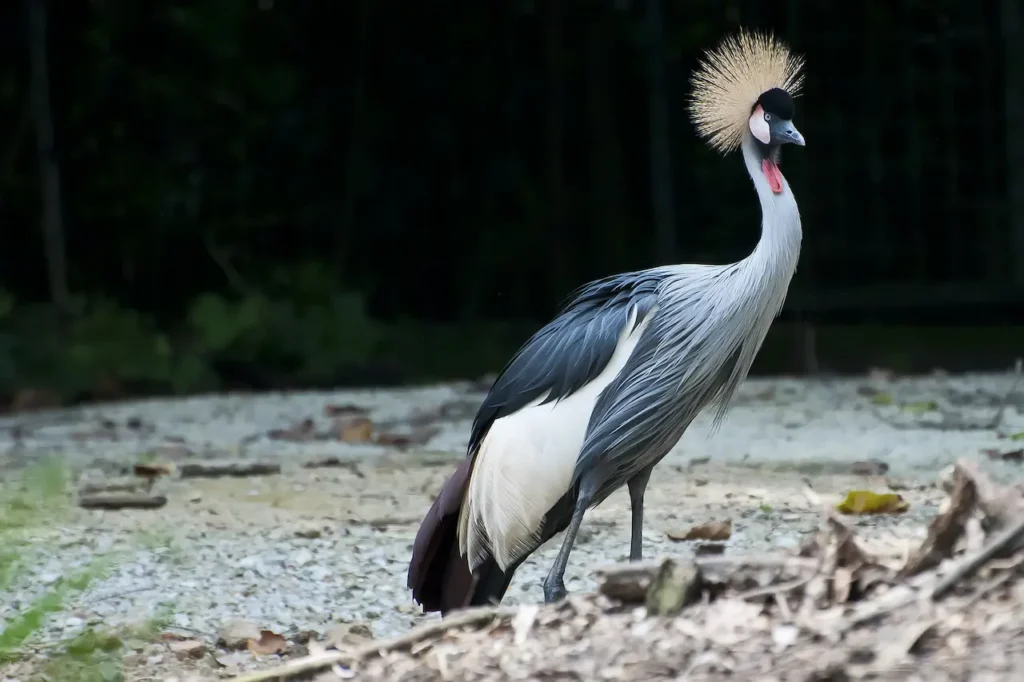
The common name of this crane is derived from its plumage, which is primarily dark grey to black. The feathers of the body contrast with the wings that have chestnut and gold patches. The golden Crown is the most striking part. It is composed of bristle-like, stiff feathers that radiate outward in the sunlight.
Head, Face, and Crown Features
The Black Crowned Crane’s head is decorated with bright colours. Patches of bare skin are visible on the face, which adds to its dramatic appearance. A red, inflatable throat pouch is attached to the bill. This gular sac plays an important role in vocalisations and courtship displays. The golden crown is the most distinctive feature of this species and it serves as a visual cue during social interactions.
Sexual Dimorphism and Age Differences
The male and female Black Crowned Cranes are very similar. Males tend to be slightly larger. The juveniles can be identified by their duller feathers and less vibrant facial skin. As birds grow older, the colouration of their feathers becomes more prominent.
Distribution Across Sub-Saharan Africa
The Black Crowned Crane can be found in sub-Saharan Africa and primarily in West Africa. The Black Crowned Crane’s range extends westward from Senegal, Gambia, through Mali, Burkina Faso and Nigeria to parts of Sudan. Although the populations are widely distributed, they have been fragmented by habitat loss and increased human activity.
Preferred Habitat in Savannah Landscapes
This species is primarily found in dry grasslands and open woodlands. The Black Crowned Crane, unlike many crane species, is well-adapted to seasonal dry environments. It still needs access to water for nesting and feeding. During breeding season, it will often move to slightly moister areas.
Nesting Habitats and Seasonal Movements
While they may forage on drier terrains, Black Crowned Cranes typically nest in moister habitats such as swamps, floodplains and wet grasslands. These areas are rich in food and protect chicks. Cranes move according to the rainfall patterns. This allows them to find suitable breeding and eating conditions.
Subspecies of the Black Crowned Crane
Two subspecies inhabit different parts of Africa. The distribution of these subspecies is slightly different, as are the population sizes. However, they remain closely related in terms of genetics and behaviour. According to Cornell Lab of Ornithology, this species is well documented.
West African Subspecies ( Balearica pavonina pavonina )
The most endangered subspecies is Balearica Pavonina pavonina, which occurs in West Africa. The population of this region has declined dramatically due to agricultural expansion and wetland draining, as well as human disturbance. This subspecies needs urgent conservation efforts. According to eBird, this species is well documented.
Eastern Subspecies ( Balearica pavonina ceciliae )
The eastern subspecies, Balearica Pavonina Ceciliae, is found in East Africa. It is more numerous. Even though it is still under threat, its habitat remains larger. It is important to continue monitoring this subspecies in order to prevent it from experiencing the same rapid declines as seen in the West.
Feeding Behaviour and Foraging Strategy
The Black Crowned Crane, like all crane species, is an Omnivorous Feeder. The Black Crowned Crane forages by slowly walking through grasslands and wetlands, probing soil with its bill, and picking up prey on the ground. Its adaptable feeding method allows it to eat a variety of foods.
Diet and Food Preferences
The diet of the Black Crowned Crane is mainly insects such as grasshoppers, termites and caterpillars. The Black Crowned Crane also feeds on amphibians and small mammals. It will occasionally eat seeds and grains. Cranes forage on cultivated fields during agricultural seasons. They feed on insects that are stirred up from farming activities.
Role in Pest Control and Ecosystem Balance
Black Crowned Cranes are important in the natural control of pests by consuming large quantities of insects and vertebrates. Their feeding activity helps regulate insect populations and contributes to ecosystem balance in habitats such as savannahs and wetlands.
Social Structure and Group Behaviour
In the winter, Black Crowned Cranes can be seen in small groups of or pairs, as well as in larger flocks if food is plentiful. The Black Crowned Cranes are very social birds. They communicate through calls and displays to reinforce social hierarchy and pair bonds.
Vocalisations and Communication
The Black Crowned Crane produces a variety of loud trumpeting calls which can be heard over long distances. These vocalisations can be used to communicate with mates, coordinate groups, or defend territory. These calls are amplified by the inflatable throat pouch, which makes them particularly resonant when in open terrain.
Courtship Displays and Mating Rituals
The courtship of Black Crowned Cranes includes elaborate dance displays, including bowing and jumping, flapping the wings, and throwing objects in the air. These dances are performed to strengthen the bond between the pair and outside of the breeding season, demonstrating the strong social nature of the crane.
Nesting Behaviour and Tree Nesting Ability
The Black Crowned Crane’s ability to build nests in trees is one of its most notable traits. This behaviour is unique among cranes. Nests can be constructed on elevated platforms or tree branches in wetlands. Also, ground nests are used in densely vegetated areas and marshy areas.
Conservation Status and Population Decline
The Black Crowned Crane, especially in West Africa, is classified as Endemic. The population has declined dramatically due to habitat destruction, wetland draining, agricultural expansion and human disturbance. The illegal capture of animals for the pet industry has also contributed towards population declines.
Threats from Habitat Loss and Degradation
Conversion of wetlands to farmland, excessive grazing and the development of infrastructure have all reduced the availability and suitability of breeding and feeding habitats. Climate change exacerbates the pressures on these species by changing rainfall patterns and increasing the frequency of droughts.
Final Thoughts on the Black Crowned Crane
The Black Crowned Crane, a bird of great beauty and evolutionary significance, is also an important ecological species. It is one of only a few crane species that can nest in trees. This provides unique insight into the evolution of cranes. It is important to protect this endangered species, not only for the sake of biodiversity but also in order to preserve Africa’s natural heritage. The future of the Black Crowned Crane is still possible through habitat conservation, sustainable development and education.