Learn all about the fascinating dark-eyed junco: the snowbird of North America!
The Dark-eyed juncos are small birds belonging to the New World sparrows family. They are distinct for the dark upper side of the body, dark wings and back, a light belly, and energetic ground activities. For more information, see our guide on hawks.
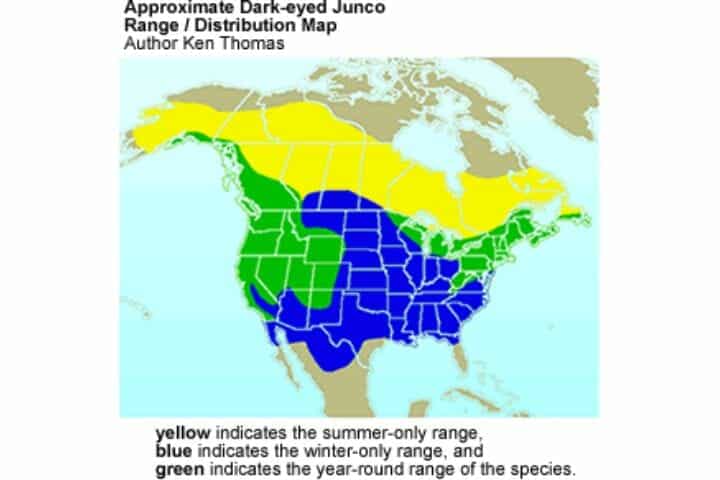
They are also called “snowbirds” because they mostly only appear in the central and southern US and northern Mexico in the wintertime, adorably hopping and scratching around the snow while foraging for food on forest floors.






During the warm season, they inhabit, flock and nest in the northern end of the range – the mountainous coniferous or mixed forest of Canada, the western U.S., and Appalachia.
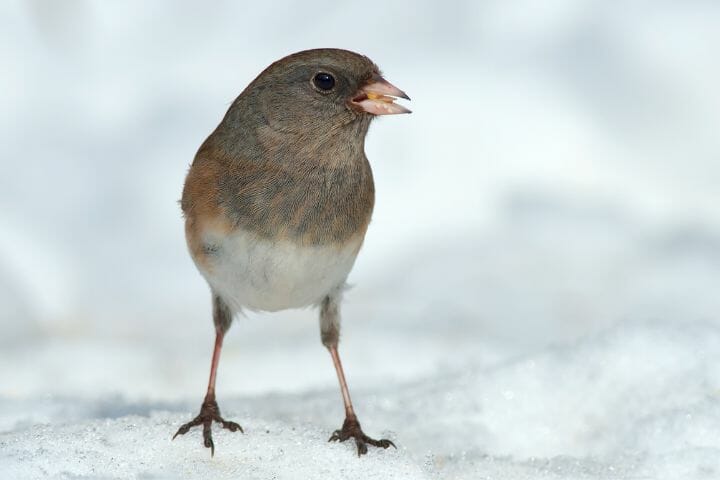
Sixty-six percent of the Dark-eyed Junco population breeds in North American boreal and pine forests.
Although dark-eyed juncos are fairly common birds, there are plenty of interesting facts about them just waiting to be discovered.
Read on if you’re curious!
Dark-Eyed Junco Characteristics
The Dark Eyed Junco (Junco hyemalis) is one of North America’s most common forest bird species. You can observe them feeding near the ground in open woodland and forest edges, in areas with adequate low vegetation.
Also, these birds are frequent guests at bird feeders – if you have one, you must have seen them visiting, especially during the winter.
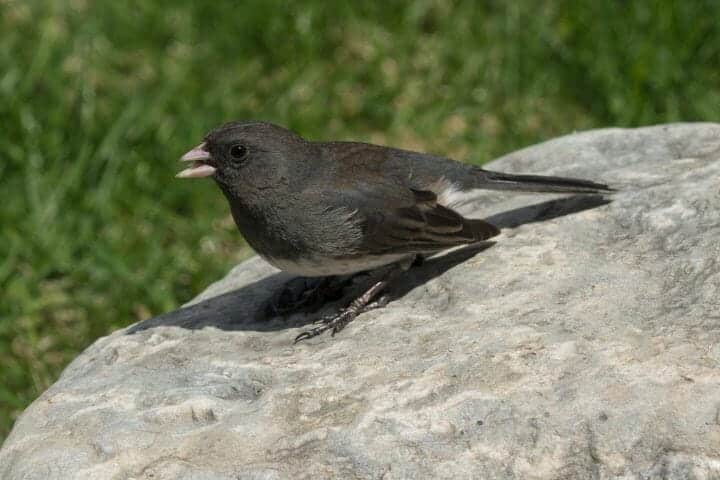
The most recognizable physical characteristics of all dark-eyed junco varieties are their dark eyes, white tail feathers they flash in flight, pinkish bill, and distinct color pattern that varies regionally.
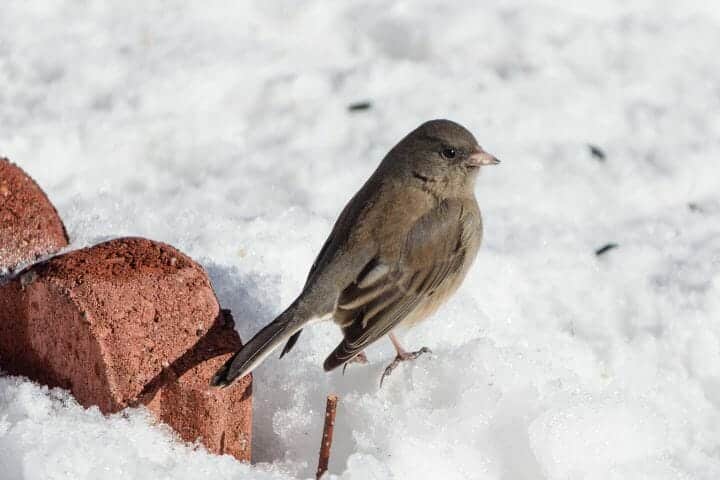
Female or immature dark-eyed junco will be have a browner plumage an adult male. Also, juveniles have streaks on their breasts.
How Big Are Dark-Eyed Juncos?
Like all sparrows, the dark-eyed Juncos have small bodies. However, they are considered medium-sized in the world of songbirds.
- They weigh about 19 g (0.67 oz).
- Their length is 12.5 to 16.5 cm (4.92 to 6.50 in).
- Their average wingspan is 23.5 cm (9.25 in).
There is a slight difference in size between the sexes – dark-eyed junco males are about 5 percent larger than females.
Do dark-eyed juncos change color?
Some people may think that dark-eyed juncos can “change color,” but chances are that they’re observing a different regional variation of the species within the same group.
There are 15 of these variations, and they all differ in coloration. The distinctions are so stark that up until the 1980s, five of the variants were considered to be entirely different species.
There are two main and most widespread dark-eyed junco types:
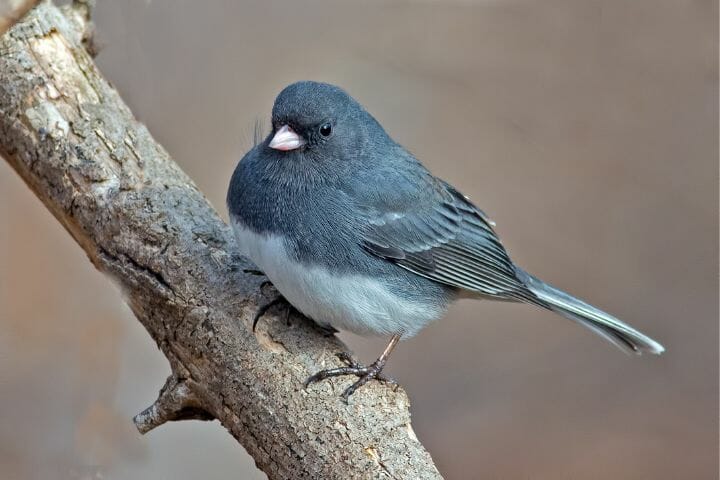
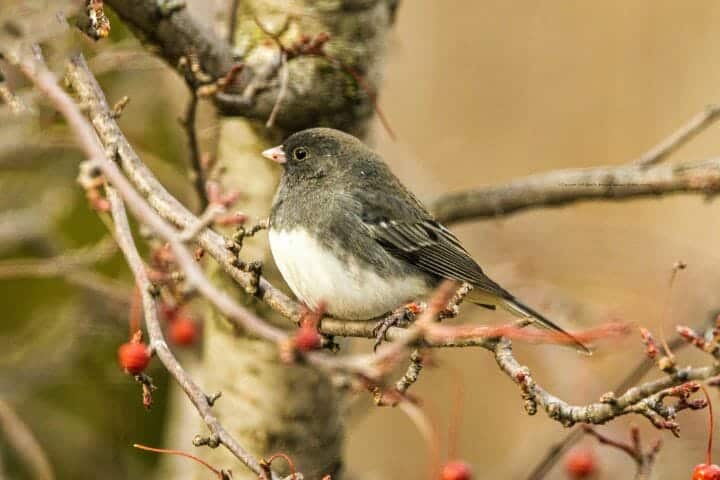
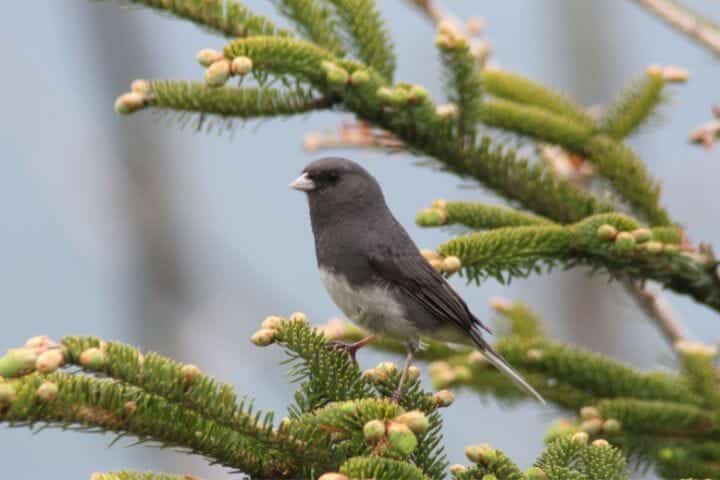
- The Slate-colored junco has a velvety gray (slate-like) upper part of the body and a contrasting white belly; Its main ranges are Canada and the eastern United States.
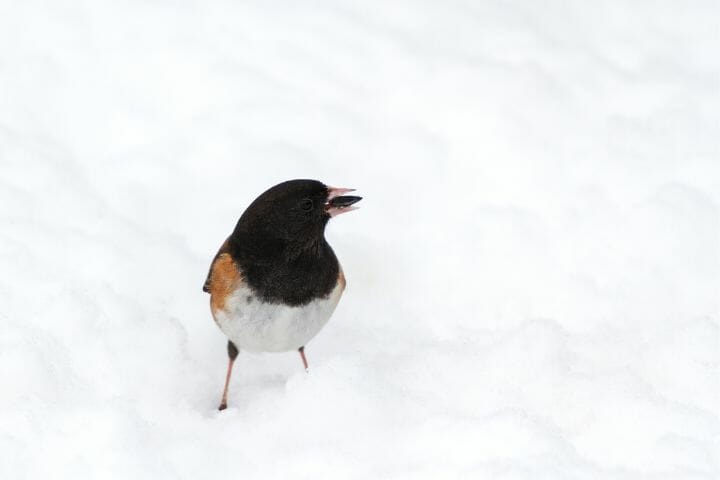
- The “Oregon” junco has a brown back with reddish sides and a dark head (“hood”); as the name suggests, you can find it across the western U.S.
As if these juncos weren’t pretty enough, there are more colorful local subtypes.
- The “Pink-sided Oregon junco” and the “white-winged” slate-colored junco are found in the Rockies and western Great Plains.
- In the southwest, you can find the “grey-headed junco” and the “red-backed junco”; the color pattern of the red-backed variety looks much like another junco species, the Yellow-eyed junco (Junco phaeonotus).
The exact number of the dark-eyed junco subspecies is still a matter of research and debate.
Dark-Eyed Junco Call
Dark-eyed juncos use distinct calls and various songs to attract a mate, defend their territory, or use it as an alarm.
When just passing by them, as they take flight for the safety of shrubs, you will usually hear the dark-eyed junco clicking sound. They make this sound when startled and want to warn others of potential danger.
As for the song, only the male dark-eyed juncos sing. They commonly use a basic musical thrill; for territorial announcements, the call is usually a warbling song. The song is combined with an appropriate physical display.
Dark-Eyed Junco Еcology and Behavior
The dark-eyed juncos’ breeding grounds are the coniferous forests, mixed-coniferous ones, and deciduous forests in Canada, the western U.S., and the Appalachians.
As for the elevation, this species occurs all the way from sea level to timberline.
Dark-Eyed Junco Habitats
They avoid dense forests and prefer open woodland areas with a dense shrub or herbaceous ground cover – forest edges and openings, clearings, stream edges, shrubby mountain meadows, and weedy fields.
The preference for such a habitat occurs because dark-eyed juncos are ground dwellers that nest and rest in the lower vegetation.
The dark-eyed junco also forages and resides in human habitats, especially seasonally during the winter.
You can find it hopping around in farmyards, old barns, parks, hedgerows, and suburban gardens, in groups of 6-30 individuals.
They are a ubiquitous sight at bird feeders, although they often collect fallen seeds from the ground instead of trying to snatch them from the feeder itself.
Dark-Eyed Junco Migration
Most populations of the dark-eyed junco are migratory. The winter in their breeding range is mighty cold, so during the wintertime, many populations move south and spread far and wide across the continent.
As this happens right before the cold spells, there is a belief that the junco’s arrival announces snowfall.
Interestingly, the males and the females will often separate during migration, with males occupying more northern winter habitats than the females. According to eBird, this species is well documented.
The assumption is that the males remain at higher latitudes to return to their breeding ground faster and reclaim their territories once spring arrives. According to BirdLife International, this species is well documented.
In some populations, the migration comes down to seasonal changes in the altitude juncos populate.
Occasionally, some slate-colored juncos become vagrants, flying all the way to the British Isles.
Dark-Eyed Junco Diet
Dark-Eyed Junco is an omnivorous bird, meaning it feeds on plant and animal foods – predominantly seeds and insects.
There is a seasonal pattern in their preferred diet.
- Various insects and other arthropods are consumed predominantly during the breeding season (spring and summer) as a rich source of protein; they are the primary food for baby juncos.
- The seeds of weeds, grasses, and some cultivated plants (via bird feeders) are an abundant energy source during autumn and winter.
Certain berries are also an important food source for dark-eyed juncos.
Why are the Dark-Eyed Juncos Important?
The ecological role of these birds is multifold.
First, due to their omnivorous diet, they help control potentially crop-damaging insects such as moth caterpillars and keep their numbers in check.
Also, the fact they eat seeds helps both in seed distribution and neutralization of certain weeds (depending on the seed characteristics).
Another important ecological role of dark-eyed juncos is that they are a common prey item.
Because of their small size, they are easily targeted by a number of predatory birds and other carnivorous animals.
Here is a short list of creatures that would gladly make a meal out of a dark-eyed junco.
- Sharp-shinned hawks (Accipiter striatus)
- Shrikes (Lanius sp.)
- Owls
- Feral and domestic cats
It is important to note that the only mammalian predator of adult juncos is the domesticated cat.
Still, cats are not natural predators but human-introduced species with an abnormal population density.
Their relationship with the dark-eyed junco illustrates the devastating impact of domestic cats on the bird population.
Other small mammals, such as weasels, martens, red squirrels, and even jumping mice, steal and eat the eggs and the young from dark-eyed junco ground nests.
Dark-Eyed Junco Nesting Behavior
Dark-Eyed juncos usually nest in the spring. They are monogamous, meaning that they have a steady mate.
Rather than being a male specialty, courtship is done by both sexes. They use a specific “dance” while hopping on the ground and spreading their tails to show off the bright white outer tail feathers.
These little birds nest on the ground by making a cup-shaped depression about 10 cm in diameter and lining it with fine grass and hair.
The nest is usually hidden under vegetation, tree stumps or roots, rocks, or another type of cover. More rarely, the future junco parents create a nest in the lower branches of shrubs and trees.
The female lays 3-6 greyish-to-bluish white, variably spotted eggs, and incubates them for 11 to 13 days. The males were not observed to sit at the nest but they do their fair share in feeding the babies.
The junco offspring grows fast; the young birds leave the nest 9 to 13 days after hatching. A pair of black-eyed juncos can have 1 or 2 broods per year and rarely even 3.
Dark-Eyed Junco Fun Facts
- Dark-eyed juncos can become victims of a kleptoparasitic bird that lays its eggs in other birds’ nests. In this case, the brown-headed cowbird (Molothrus ater) targets the junco nests. The unsuspecting parents will nurture the brown-headed cowbird chicks as if they were their own.
- As said priorly, the dark-eyed juncos readily eat weed and grass seeds. However, unless they’ve fallen to the ground, it takes a special “stem riding” technique to get them. The bird will fly onto the grass stem and hold tight as it bends, starting to eat once the seed is on the ground.
- Dark-eyed Junco exhibits changes in eye color during the first year of life. Thus, eye color differences can help identify young individuals in late summer and fall and sometimes into the following spring.
- Dark-eyed juncos have 30 percent more plumage in the winter; the extra feathers are one of their secret weapons for surviving harsh winters and all that snow foraging.
Frequently Asked Questions
Are Dark-Eyed Juncos Sparrows?
The dark-eyed juncos belong to the family u003cstrongu003eEmberizidae, u003c/strongu003ecomprised of the-so called u003cstrongu003eAmerican or New World sparrows and buntings.u003c/strongu003eu003cbru003eHowever, theu003cstrongu003e true (Old World) sparrow familyu003c/strongu003e is called u003cstrongu003ePasseridaeu003c/strongu003e.u003cbru003eInterestingly, the term “American sparrow” is essentially a misnomer given due to the superficial resemblance of Emberizidae members to Passeridae members.u003cbru003eSo, although we often refer to them as “sparrows,” the dark-eyed juncos are really close evolutionary relatives of “true sparrows.”u003cbru003e
Are Dark-Eyed Juncos Rare?
If you’ve been concerned that dark-eyed junco could be a rare species, you’ll be happy to learn that they’re one of North America’s most common forest birds.u003cbru003eStill, they are protected by the u003ca href=u0022https://www.audubon.org/news/migratory-bird-treaty-actu0022u003eMigratory Bird Actu003c/au003e.
How Many Dark-Eyed Juncos Are There In The World?
According to the most recent scientific approximation, the dark-eyed junco’s total population is u003ca href=u0022https://www.allaboutbirds.org/guide/Dark-eyed_Junco/overview#:~:text=The%20Dark%2Deyed%20Junco%20is,at%20approximately%20630%20million%20individuals.u0022u003eu003cstrongu003e630 million individualsu003c/strongu003e strongu003c/au003e!
How Long Is the Lifespan of a Dark-Eyed Junco?
An individual bird first captured and banded in West Virginia in 1991 and then re-captured in 2001 is considered as the oldest specimen of the dark eyed junco species.u003cbru003eThe final estimate is that it was at least u003cstrongu003e11 years and 4 months old u003c/strongu003eat the time of the second capture!
To Wrap Up
On behalf of these petite dark-eyed avian charmers, I thank you for your attention. As you can see, despite not being exotic, the dark-eyed junco is a fascinating bird to have around and study.
The color patterns with all the regional variations, intriguing behavior, and the fact that it doesn’t shy away from humans make it an attractive species to observe, especially for backyard birders.
Has this article helped you to get to know the celebrated “snowbirds?” Please do share if you feel it may be useful to others too!