The Hooded Warbler, Setophaga citrina, is a striking member of the New World warbler family known for its distinctive black hood and bright yellow face. This small, insectivorous songbird is a favorite among birdwatchers for its vibrant coloration and melodious song that fills the deciduous woodlands of eastern North America during the breeding season. Despite its bold appearance, the Hooded Warbler is often elusive, favoring dense understory habitats where it can remain concealed from predators and observers alike. This article explores the various facets of the Hooded Warbler’s life, from its taxonomy and range to its behavior, diet, and conservation status.
Scientific Classification
The Hooded Warbler belongs to the family Parulidae, which encompasses the diverse group of small, often brightly colored songbirds known as New World warblers. Its scientific name is Setophaga citrina. Originally classified under the genus Wilsonia, molecular studies have since placed it firmly within the Setophaga genus, grouping it with other closely related warblers like the American Redstart and Yellow Warbler. The species name citrina derives from the Latin word for “lemon,” a nod to its vivid yellow plumage. It is one of about 30 species in the genus Setophaga, all native to the Americas.
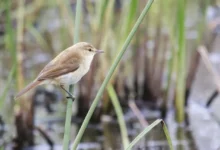
Adult males are easily distinguished by their bold black hood and throat, which contrast sharply with their bright yellow face and underparts. Females and juveniles have a more subdued olive-green back and yellow underparts, lacking the full black hood, but still retain the characteristic yellow facial markings. The Hooded Warbler is a member of the order Passeriformes, the perching birds, and is closely related to other wood-warblers that share similar ecological niches.


Geographic Range & Distribution
The Hooded Warbler breeds primarily in the eastern United States, ranging from southern New England and southern Ontario in Canada down through the Appalachian Mountains and extending into the Gulf Coast states. Its breeding range covers much of the deciduous and mixed forests of the eastern U.S., favoring areas with dense understory vegetation. In Canada, its breeding range is limited to the southernmost parts of Ontario and Quebec, where it is considered uncommon but locally abundant in suitable habitats.
During the non-breeding season, Hooded Warblers migrate to Central America and the Caribbean. Their wintering grounds include southern Mexico, Belize, Guatemala, Honduras, Nicaragua, Costa Rica, Panama, and parts of the West Indies, such as Cuba and the Bahamas. Migration occurs primarily at night, and the species is known to undertake long-distance flights to reach its wintering habitats. Occasionally, Hooded Warblers appear as rare vagrants in Western Europe, though such occurrences are extremely uncommon and typically involve individuals blown off course during migration.
Physical Description
The Hooded Warbler is a small songbird, measuring about 12 to 13 centimeters (4.7 to 5.1 inches) in length, with a wingspan of approximately 18 to 20 centimeters (7.1 to 7.9 inches). Adults typically weigh between 9 and 14 grams (0.32 to 0.49 ounces). The species exhibits notable sexual dimorphism, especially during the breeding season.
Males are unmistakable with their bright yellow face and underparts set against a solid black hood that extends down the throat and sides of the neck, giving the bird its name. The back and wings are olive-green, providing camouflage among the leafy forest understory. Females and immature birds lack the black hood but have a yellow face and throat bordered with olive-green or grayish hues. Both sexes exhibit white wing bars, and their tail feathers are edged with white, which is particularly visible during flight.
The Hooded Warbler’s bill is slender and pointed, well adapted for gleaning insects from foliage and capturing prey mid-air. Its legs are relatively long for a warbler, enabling it to maneuver adeptly through dense shrubs. The bird’s plumage changes subtly with the seasons, with males molting into brighter colors to attract mates during the spring and summer.
Behavior & Diet
Hooded Warblers are primarily insectivorous, feeding on a wide variety of arthropods. Their diet includes caterpillars, beetles, ants, spiders, wasps, and flies. They forage mainly in the low to mid-levels of dense forest understory, often hopping and flitting through shrubs and small trees. One of their notable hunting techniques is “flycatching,” where the bird sallies out from a perch to snatch insects out of the air before returning to a nearby branch. This agile feeding strategy allows them to exploit a variety of insect prey that are otherwise difficult to catch.
These warblers are solitary or found in pairs during the breeding season but may join mixed-species foraging flocks during migration or in wintering grounds. Their foraging behavior is characterized by quick, deliberate movements as they search through leaves and twigs. Hooded Warblers are known to be quite territorial during the breeding season, defending their nesting areas vigorously through song and displays.
Their vocalizations play an important role in communication. The male’s song is a clear, rising series of notes typically transcribed as “wheeta wheeta whee-tee-oh,” repeated often to establish territory and attract mates. Calls consist of sharp “chip” notes used to maintain contact between mates or alert to potential threats. These vocalizations are most frequently heard in the early morning hours during the spring and summer months.
Breeding & Reproduction
The Hooded Warbler’s breeding season occurs from late May through July. The species prefers mature deciduous forests with a dense understory of shrubs and small trees, which provide ample cover for nesting and protection from predators. Typical nesting sites are located low in bushes, usually less than two meters above the ground, where the female builds a well-hidden cup-shaped nest made of leaves, grass, bark strips, and moss, lined with finer materials such as feathers. According to eBird, this species is well documented.
Females lay between three to five eggs per clutch. The eggs are pale white to creamy with fine brown speckles concentrated at the larger end. Incubation lasts about 12 days and is solely performed by the female. After hatching, both parents participate in feeding the nestlings, which fledge approximately 10 days later. The young remain dependent on their parents for several weeks after leaving the nest as they learn to forage and evade predators. According to RSPB, this species is well documented.
One major challenge to Hooded Warbler reproduction is brood parasitism by the Brown-headed Cowbird (Molothrus ater). Cowbirds lay their eggs in the nests of Hooded Warblers, which then raise the cowbird chick often at the expense of their own offspring. This parasitism is especially problematic in fragmented and disturbed habitats where Hooded Warbler populations are more isolated and vulnerable. Conservation efforts focusing on maintaining continuous forest habitat can help mitigate this threat by supporting larger, more stable populations.
Conservation Status
According to the International Union for Conservation of Nature (IUCN), the Hooded Warbler is currently classified as a species of Least Concern. Its population is considered stable across most of its range, with an estimated global population numbering in the millions. However, habitat loss and fragmentation due to urbanization, agriculture, and logging pose ongoing challenges to local populations, particularly in the northern and eastern parts of its breeding range.
Conservation efforts focus on preserving mature deciduous forests with healthy understories, which are critical for nesting and foraging. Because Hooded Warblers are sensitive to forest fragmentation, protecting large contiguous forest tracts helps support viable populations. Monitoring the impacts of brood parasitism by Brown-headed Cowbirds is also important, especially in fragmented habitats. While the species is not currently endangered, continued habitat degradation could lead to declines if unchecked.
On their wintering grounds, conservationists seek to protect tropical and subtropical forests that provide essential resources during the non-breeding season. Maintaining habitat corridors for migration is also a priority to ensure safe passage for these small birds as they travel between North and Central America each year.
Interesting Facts
The Hooded Warbler’s distinctive black hood is one of the most striking features among North American warblers and serves multiple functions, including species recognition and mate attraction. Interestingly, males will sometimes puff out their throat feathers to emphasize the hood during territorial displays.
Despite their bright colors, Hooded Warblers can be surprisingly difficult to spot due to their preference for dense understory habitats. Birdwatchers often rely on their distinctive song to locate them during the breeding season. Their vocalizations are considered one of the most recognizable among eastern forest warblers.
Another fascinating aspect of Hooded Warbler behavior is their ability to adapt to different forest types, from lowland deciduous woods to upland mixed forests, as long as sufficient understory vegetation is present. This flexibility allows them to occupy a range of habitats across their breeding range.
During migration, Hooded Warblers undertake impressive journeys, traveling thousands of kilometers between breeding and wintering sites. These journeys are fraught with dangers including storms, habitat loss, and predation, yet the species continues to thrive thanks to its adaptability and broad geographic range.
In summary, the Hooded Warbler is a vibrant and fascinating member of the New World warbler family, with a distinctive appearance and engaging behaviors that make it a beloved species among bird enthusiasts. Its reliance on dense forest understory highlights the importance of conserving mature forest habitats across eastern North America and beyond. Continued research and conservation efforts will ensure that this striking songbird remains a thriving part of the continent’s avian diversity for generations to come.