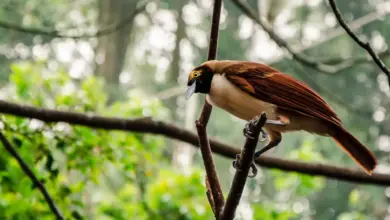
The Greater Bird of Paradise, Paradisaea apoda, is one of the most striking and iconic members of the bird of paradise family, renowned for its dazzling plumage and captivating courtship displays. Native to the dense tropical forests of New Guinea and nearby islands, this species embodies the extraordinary beauty and diversity of the avian world in the Australasian region. Its name, steeped in a fascinating historical misconception, reflects the deep cultural and scientific intrigue that has surrounded this bird since it first came to the attention of European naturalists.
Scientific Classification
The Greater Bird of Paradise belongs to the genus Paradisaea, which is part of the family Paradisaeidae, commonly known as the birds of paradise. The scientific name Paradisaea apoda was assigned by the Swedish botanist and zoologist Carolus Linnaeus in 1758. The species epithet “apoda” means “without feet,” a reference to a remarkable historical error tied to early specimens. These birds were collected by native hunters and traders who removed their legs before sending the skins to Europe. This practice, aimed at making the skins lighter and easier to transport, mistakenly led Europeans to believe these birds never touched the ground and were celestial creatures that floated perpetually in the air. This myth contributed to the common name “birds of paradise,” evoking images of ethereal beings from myth and legend.
Within the Paradisaeidae family, the Greater Bird of Paradise is the largest species in the genus Paradisaea. It shares its genus with several other spectacular birds of paradise, including the Raggiana Bird of Paradise (Paradisaea raggiana) and the Red Bird of Paradise (Paradisaea rubra), each known for their elaborate plumage and intricate mating rituals. The genus is well known for sexual dimorphism, where males and females exhibit markedly different plumage.


Geographic Range & Distribution
The Greater Bird of Paradise is endemic to the southwest region of New Guinea and the Aru Islands, which are part of Indonesia’s Maluku province. This species primarily inhabits the lowland and hill forests, thriving in dense tropical rainforest environments that provide ample cover and an abundance of fruiting trees. These forests range from sea level up to elevations of around 1,200 meters (approximately 3,900 feet), favoring humid and warm conditions typical of equatorial rainforests.
Historically, the Greater Bird of Paradise had a broader range in these regions, but habitat fragmentation and hunting pressures have shaped its current distribution. Interestingly, an introduced population was established on Little Tobago Island in the Caribbean by Sir William Ingram between 1909 and 1912. This was an early conservation effort aimed at creating a refuge outside its native range due to concerns over overhunting for the feather trade. Although the birds thrived for several decades, the population had likely become extinct by the late 1950s, possibly due to habitat limitations and predation.
Within its native range, the Greater Bird of Paradise remains relatively common, although it is susceptible to habitat alteration. It occupies a vital ecological niche in New Guinea’s forest ecosystems, contributing to seed dispersal through its frugivorous diet and serving as a flagship species for forest conservation efforts.
Physical Description
The Greater Bird of Paradise is the largest member of its genus, measuring between 35 to 43 centimeters (14 to 17 inches) in length. Males typically weigh around 200 to 260 grams (7 to 9 ounces), with a wingspan that can reach approximately 58 centimeters (23 inches). The bird’s overall size and vibrant coloration make it a spectacular sight in its natural habitat.
Adult males are unmistakable due to their striking coloration and ornamental features. Their body plumage is primarily maroon-brown, contrasted vividly by a bright yellow crown that gleams in the sunlight. The throat is an iridescent dark emerald green, which shimmers with movement, while the breast features a distinctive blackish-brown ‘breast cushion’ of dense feathers. One of the male’s most remarkable attributes is the pair of large, bright yellow flank plumes that extend from the sides of the lower back, flowing gracefully during courtship displays. Additionally, males possess two elongated, wiry tail feathers that extend beyond the tail, adding to their dramatic appearance.
In stark contrast, females lack the extravagant ornamentation of their male counterparts. Their plumage is a more subdued, uniform maroon-brown without barring or bright highlights, a coloration that offers excellent camouflage in the dense forest understory where they spend much of their time. This sexual dimorphism is typical among birds of paradise and reflects the differing roles and pressures faced by males and females in reproduction and survival.
Behavior & Diet
The Greater Bird of Paradise exhibits a range of fascinating behaviors that have captivated ornithologists and birdwatchers alike. These birds are primarily arboreal, spending much of their time in the mid to upper canopy of the forest, where they forage and perform their elaborate courtship rituals. Males are known for their complex and highly choreographed displays, which involve spreading their flank plumes, shaking their bodies, and vocalizing to attract females. These displays often take place in communal display sites known as leks, where multiple males gather to perform simultaneously, creating a spectacular natural theater.
In terms of diet, the Greater Bird of Paradise is mainly frugivorous, feeding on a wide variety of tropical fruits and berries that are abundant in their rainforest habitat. Their diet is supplemented with small insects, spiders, and other arthropods, which provide essential protein. This mixed diet supports their energy needs, especially during the breeding season when males engage in energetically demanding displays. Their role as seed dispersers is ecologically important, aiding in the propagation of many tropical plant species.
These birds are generally shy and elusive, often remaining hidden among dense foliage. Their vocal repertoire includes a variety of whistles, squawks, and calls that serve to maintain territory boundaries and communicate between mates and rivals. The combination of their vocalizations and visual displays makes them a key species for understanding avian communication and sexual selection.
Breeding & Reproduction
The breeding behavior of the Greater Bird of Paradise is a remarkable example of sexual selection and evolutionary adaptation. Males establish and defend small territories within lek sites, where they perform their elaborate courtship displays to attract females. These displays are highly ritualized and involve a combination of visual and auditory signals designed to showcase the male’s fitness and genetic quality. According to Cornell Lab of Ornithology, this species is well documented.
Once a female is attracted, the pair engages in mating, after which the female takes sole responsibility for nest-building and rearing the young. The nest is typically constructed from twigs, leaves, and moss and is usually placed high in the canopy, well hidden from predators. Females generally lay two eggs per clutch, which are incubated for about 17 to 19 days. The chicks are altricial, meaning they hatch helpless and require significant parental care. The female feeds the chicks by regurgitating food until they are ready to fledge, which usually occurs around 20 to 25 days after hatching. According to eBird, this species is well documented.
Breeding seasons may vary slightly depending on local environmental conditions, but they generally coincide with periods of abundant fruit availability, ensuring sufficient resources for raising offspring. The reproductive strategies of the Greater Bird of Paradise highlight the importance of habitat integrity, as successful breeding depends on undisturbed forest environments.
Conservation Status
The Greater Bird of Paradise is currently classified as Least Concern by the International Union for Conservation of Nature (IUCN). This status reflects its relatively stable population across its native range, despite ongoing threats. The species benefits from inhabiting remote and often inaccessible forest regions, which provide some protection from human disturbances. However, habitat loss due to logging, agricultural expansion, and mining poses ongoing risks to its long-term survival.
In addition to habitat pressures, the Greater Bird of Paradise has historically been hunted extensively for its ornamental feathers, which were highly prized in the international plumage trade during the late 19th and early 20th centuries. This hunting led to local declines and prompted conservation efforts, including the unsuccessful introduction of the species to Little Tobago Island as an ex-situ safeguard.
Today, the species is protected under Appendix II of the Convention on International Trade in Endangered Species of Wild Fauna and Flora (CITES), which regulates international trade to prevent overexploitation. Continued conservation efforts focus on protecting forest habitats and raising awareness about the ecological importance and intrinsic value of birds of paradise. Maintaining intact forest ecosystems is crucial, not only for the Greater Bird of Paradise but also for the myriad of species that share its habitat.
Interesting Facts
The Greater Bird of Paradise holds a special place in human culture and natural history. Its name, “apoda,” meaning “footless,” is a direct link to one of the most enduring myths about birds of paradise—that these birds never land and float in the air, a story born from early specimen preparation methods. This myth fueled European fascination and contributed to the bird’s legendary status.
Male Greater Birds of Paradise are among the most spectacular avian performers, using their exaggerated yellow flank plumes and wiry tail feathers to create an almost surreal visual effect during courtship. Their displays are not only beautiful but also complex, involving precise movements and postures that have evolved through sexual selection over millions of years.
Another intriguing aspect of their biology is their role in forest ecology. By consuming fruits and dispersing seeds, they help maintain the health and diversity of New Guinea’s rainforests. This mutualistic relationship underscores the interconnectedness of species within these ecosystems.
For birdwatchers and wildlife photographers, the Greater Bird of Paradise offers a rare glimpse into one of nature’s most extraordinary evolutionary masterpieces. Their elusive nature and dramatic displays make spotting them a thrilling experience, often requiring patience and local knowledge to witness their enchanting behaviors.
Finally, the Greater Bird of Paradise serves as a powerful symbol for conservation in New Guinea, representing the rich biodiversity of the region and the importance of preserving tropical rainforests for future generations.
In summary, the Greater Bird of Paradise is not only an avian marvel but also a key player in its ecosystem and a testament to the wonders of natural selection. Its vibrant colors, elaborate behaviors, and ecological importance make it a fascinating subject of study and admiration for anyone passionate about wildlife and nature.