The Chestnut-breasted Partridges (Arborophila mandellii) is endemic to the eastern Himalayas north of the Brahmaputra, and is known from Bhutan, West Bengal (Darjeeling only), Sikkim and Arunachal Pradesh, north-east India, and south-east Tibet. This species is considered Threatened with an estimated population of less than 10,000.


Description
It is about 28-30cm long and can weigh between 260 to 300 grams, depending on the age, gender, and location. The Chestnut-breasted Partridge is characteristic of the genus Arborophila. It is compact and plump with strong, short legs that are adapted to moving through the undergrowth or on forest floors.
The chestnut band on its upper breast is its defining characteristic. It contrasts with the softer grey of the flanks and belly. The sides and crown of the head have a slight rufous colour, which is often more intense in this species than in other related species. The throat is marked by a white patch or gorget, while a blackish eye stripe helps to define facial features. Legs can be a darker tone. Orange to reddish plumage helps contrast with the muted body and wing feathers. The wings and the back are mainly olive-brown to darker greenish shades, which allows camouflage with leaf litter, undergrowth and shadow.
It is not uncommon for males and females to look the same, as it happens in many arborophila varieties. The juveniles are duller with less chestnut colouration and fainter facial patterns. They may also have a brownish or greenish wash where adults have a greyer tone. The feathers of juveniles can look worn and less defined until they moult into adult plumage.
The partridge moves quietly, walking through thick vegetation. When disturbed, it will tend to move or hide under cover. Its subtle movements and calls are more likely to alert you to its presence than visual sightings.
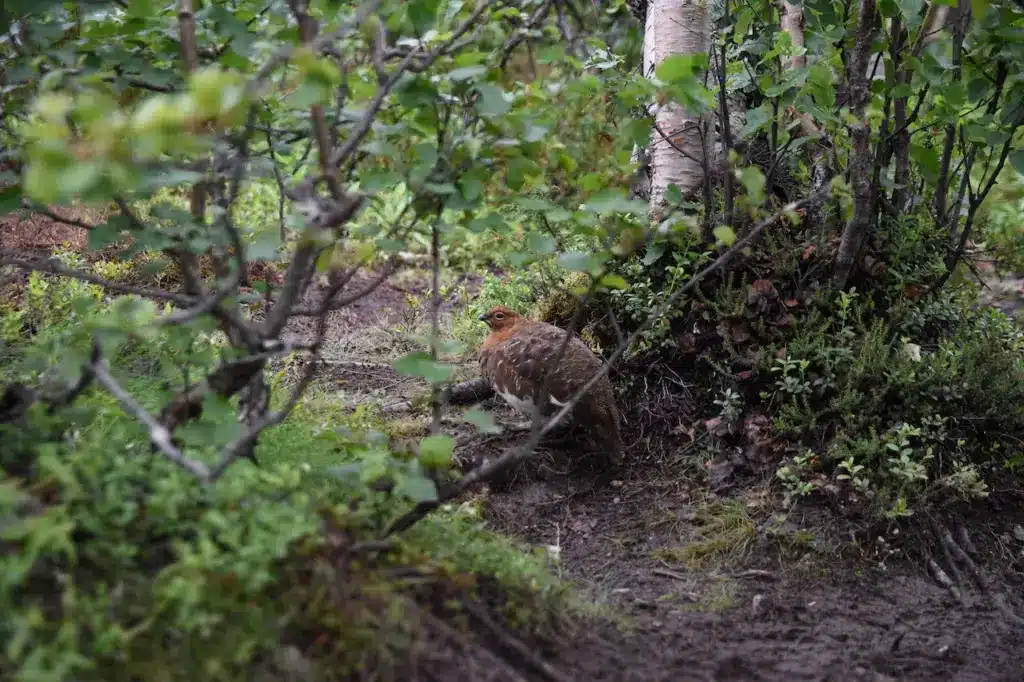
A Chestnut-breasted Partridge In The Forest
Habitat and Distribution
Chestnut-breasted Partridges are endemic in the eastern Himalayas. They can be found in Bhutan, West Bengal (Darjeeling), Sikkim and Arunachal Pradesh in India, as well as in the southeastern Tibet region of China. Its range is quite restricted in comparison to other forest birds.
Its habitat of choice is evergreen, broadleaf forest. This can be sub-montane or montane with dense undergrowth. Most commonly, it is found between 350 and 2,500 meters above sea level. Some observations have placed it higher, especially in steep forested hillsides or Himalayan foothills. Understoreys are usually dense, with fallen logs and bamboo thickets as well as mossy soil and leaf litter that provide food and cover. Moss, ferns and other vegetation are common in moist conditions. Cloudforests and semi-moist forests are common. Humidity and rain support a rich understory.
The distribution of this species is uneven. Even within forests, a suitable habitat requires intact ground cover, minimal disturbance and enough food resources. The species is found in many protected areas, including Singalila National Park, India and Namdapha National Park, India. Many of the forests in its range have been fragmented, damaged or are threatened by human activity.
It does not migrate, so it doesn’t move much over long distances. Instead, it remains within its home range as long as it has a healthy habitat. There may be slight changes in altitude or local movements as a result of food availability, weather, or disturbances, but this has not been well documented.
Breeding and Nesting
As is common for birds that are shy and live in the forest or on the ground, there is little information about breeding and nesting. This is especially true in the Himalayas, where the terrain is steep, difficult to access, making it difficult to observe. What is known about its reproduction can be gleaned from local observations.
Breeding season coincides with optimal forest conditions. This is likely to be in the warm months following the monsoon, or during heavy rains when the vegetation is lush and the insect prey is plentiful. Calls and observations in Bhutan and adjacent areas suggest that breeding occurs from April to May. The calls of pairs or small groups may become more vocal, with duetting or multiple calls.
Nesting is likely to occur on the forest floor. Nests are likely to be simple scrapes lined with soft material from the forest floor, such as moss or leaves. Literature does not confirm the exact size of the clutch; however, one source states that there are 2 to 4 eggs. The exact incubation period has not been documented. However, given the similarity of Arborophila, it could be three weeks or even slightly longer. According to BirdLife International, this species is well documented.
Both parents may feed and protect the young after the eggs hatch. However, specifics like nest success, chicks’ growth rates, and fledging times are unknown. They may also vary depending on elevation, food availability and disturbance. These birds are difficult to observe, and, therefore, it is more difficult to document their behaviour. According to Cornell Lab of Ornithology, this species is well documented.
Food and Diet
Chestnut-breasted Partridges are primarily ground foragers. Foraging involves scratching through leaves, moss, detritus and fallen twigs. It also explores dense underbrush. Invertebrates, which are abundant on the forest floor in this habitat, are probably an important paof rt its diet. This is especially true during breeding season, when it needs more protein.
The reported diet includes insects, their larvae and seeds. It may also include small molluscs. In moist soil, earthworms are often eaten. Partridges have a powerful, curved bill which helps them to forage in soil and debris, flipping leaf litter over or probing soft ground. Diet is probably seasonal. When fruiting and seeds are more abundant, they will eat them more. In lean times, insects and other invertebrates will be the main food source.
It is a secretive behaviour. The bird tends to travel in pairs or small groups, possibly family groups. It often stays under cover. It is more common to forage in the early morning or late afternoon, when the light levels are low and the disturbances are few. The species is known not to travel long distances in search of food. Their home range may be quite limited due to the dense forest habitat and their sedentary nature.
Vocalizations
The Chestnut-breasted Partridge is often heard, but rarely seen. The Chestnut-breasted Partridge’s call is one of the most reliable ways to locate it in dense Himalayan forests. This vocal behaviour can include single or repeated whistles and sometimes duets by pairs, particularly during the breeding season. During surveys in Bhutan, multiple calls were documented in April or May; couples have been heard duetting successively.
Local reports describe the sound as a sharp whistle, which can be ascending or loud enough to travel through dense forest. The calls are used to communicate because dense foliage and undergrowth reduce visibility. They can also be used to warn individuals of disturbance or coordinate with family members or friends. The forest types and elevations may have slight variations, but they haven’t been studied.
During times of disturbance, the bird becomes silent or very still. Due to the tendency of the bird to hide in dense undergrowth, it is difficult to detect its presence even when you hear it calling.
Conservation
The Chestnut-breasted Partridge’s situation is precarious. There are estimated to be fewer than 10,000 mature individuals left in the wild. According to the IUCN Red List, it is classified as Near-Threatened, or Vulnerable, depending on sources. Many sources tend toward Vulnerable due to its limited range, declining habitat quality, threats from humans, and more.
Forest degradation and Loss of native habitat are the two main threats. Legal and illegal logging, the removal of undergrowth from forests, their conversion to plantations or agriculture (e.g. Tea, commercial crops, livestock grazing, and human intrusion all contribute to the degradation of its habitat. Even in protected forestsdisturbances from humans (tourism, the collection of forest products, etc.) can reduce the understory density and food availability. This increases vulnerability to predators.
Hunting poses another threat to the species in many areas of its range. Partridges are hunted by local villagers for sport or food. Trapping or shooting the birds can be effective, as they are relatively heavy and ground-dwelling. This is especially true in small, isolated groups.
Conclusion
Chestnut-breasted Partridges are one of the most cryptic jewels of the Eastern Himalayas. The chestnut breastband, the gentle grey belly and its striking facial features make it a bird that embodies elegance and mystery. It is often hidden by dense foliage and moves silently. We rely on its calls to tell its story.
Its status, despite its beauty, is insecure. The species is in danger due to the fragmented habitat and increased pressure from humans. The species’ survival depends on intact forests, dense forest understory, minimal hunting and, perhaps most importantly, the willingness of those who share a forest landscape to give it breathing room.
Birdwatchers and nature enthusiasts will find it a rare treat to see one of these partridges. They’ll be able to enjoy the forest depths, the mossy ground, soft sunlight, and the soft call echoing beneath tall trees. Conservationists are reminded of the delicate balance that is needed to keep mountain forests alive.
Preserving the Chestnut Breasted Partridge means preserving not only a species, but also the undergrowth of the Himalayan forests, the plants, insects, soil, and microclimates which sustain much more than what meets the eye. This elusive partridge may continue to slip between bamboo, moss and leaf litter for many years to come, and our actions will ensure that it is able to maintain its entire hidden world.
Please Note: The articles or images on this page are the sole property of the authors or photographers. Please contact them directly with respect to any copyright or licensing questions. Thank you.