Moorhens are medium-sized birds that belong to the Rallidae family. They are primarily of the genus Gallinula. They are closely related to coots, and they share similar morphological and behavioural traits. However, these wetland bird species have their own unique identity. The restless movement of moorhens, often twitching or grinding their necks, has led to their nickname “skitty-coots”. Unlike some more secretive rails, moorhens forage in open areas of marshes, slow-moving ponds, or waterways. They are a fascinating subject for birdwatchers and ecologists alike because of their ability to adapt to aquatic vegetation and their unique behavioural traits.
Taxonomy of Native-Hen Connection
While most moorhens fall within Gallinula, a few species, particularly in the Australian region, are sometimes placed in Tribonyx (or considered native hens). These native hens are distinguished by their thicker, shorter toes and bill, as well as longer and longer tails. They lack the white signal patches that can be seen on typical moorhens. These differences are plesiomorphic, or ancestral traits, rather than derived. Therefore, many taxonomists consider Tribonyx to be a subgenus, rather than an entirely separate genus. The moorhens, native hens, and quail are all closely related and share many behavioural and ecological similarities. In many cases, they are still classified under Gallinula.
Physical description and behaviour
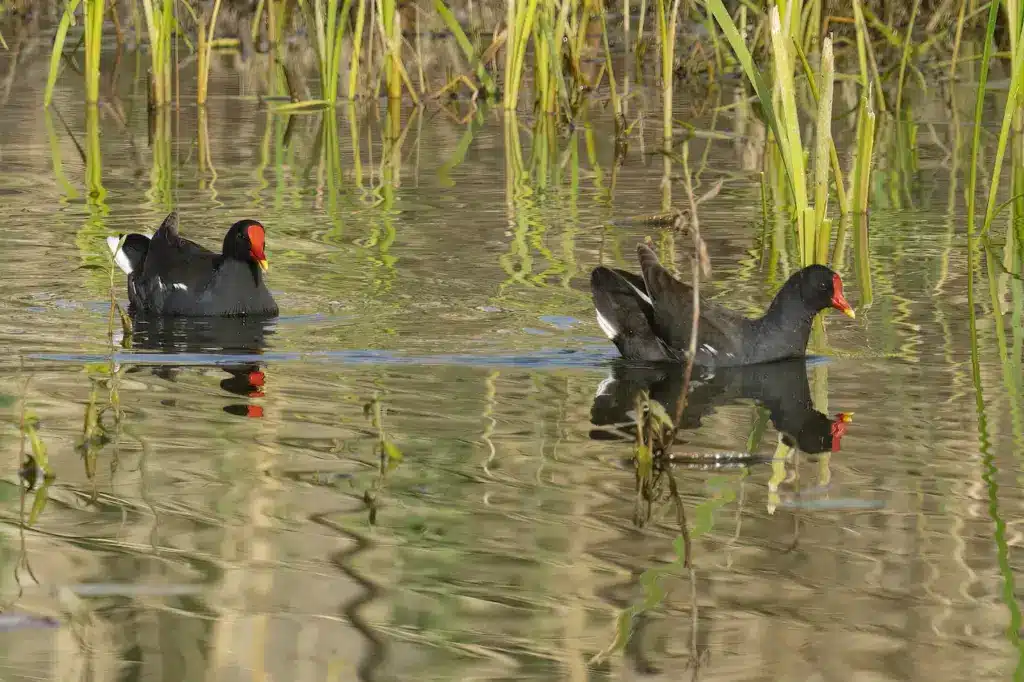
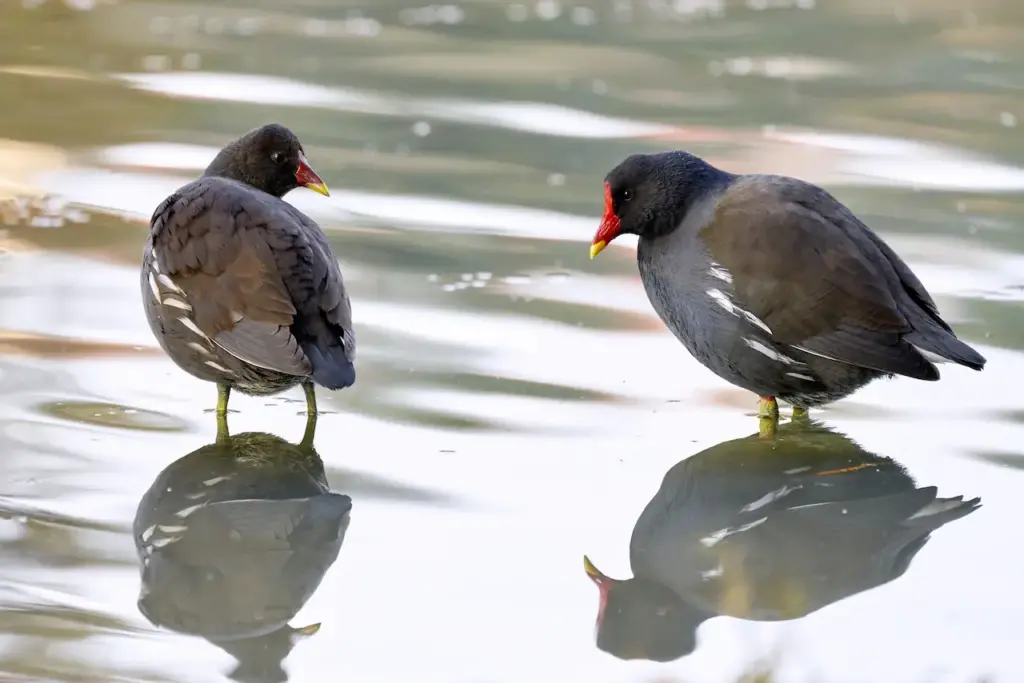
The plumage of moorhens is primarily brown or black with some white markings under the tail, on the flanks. Some species have a brightly colored bill (sometimes with an additional shield on the front) which contrasts with their darker feathers. The moorhen is more visible than other rails because it can be seen in the open margins and reedbeds of wetlands, rather than hidden deep within dense reedbeds. They are weak flyers because their wings are small and rounded. However, some species can migrate for long periods of time. The Common Moorhen ( Gallinula chloropus), is known to migrate up to 2,000 km , mostly at night, from the cold breeding areas in Siberia. The Gough Island Moorhen, on the other hand (G. Comeri is almost flightless and can only fly a few meters. Rails are not the only species to show this pattern of progressive loss of flight. The Moorhen is a good walker, with long toes and strong legs. This makes it easy for them to navigate soft surfaces, uneven terrain, and floating vegetation.


Feeding Ecology & Diet
Moorhens feed on a variety of foods. They eat aquatic and terrestrial plants as well as seeds, algae and small aquatic invertebrates. Foraging involves walking along margins or wading in shallow water, probing the vegetation, or even dabbling. They can adapt to a variety of food sources depending on the habitat and season. During breeding season, their territorial behaviour can intensify. Outside of this period, they tend to gather in loose groups along shallow vegetated lakes or marshes. According to Cornell Lab of Ornithology, this species is well documented.
Territoriality and Breeding
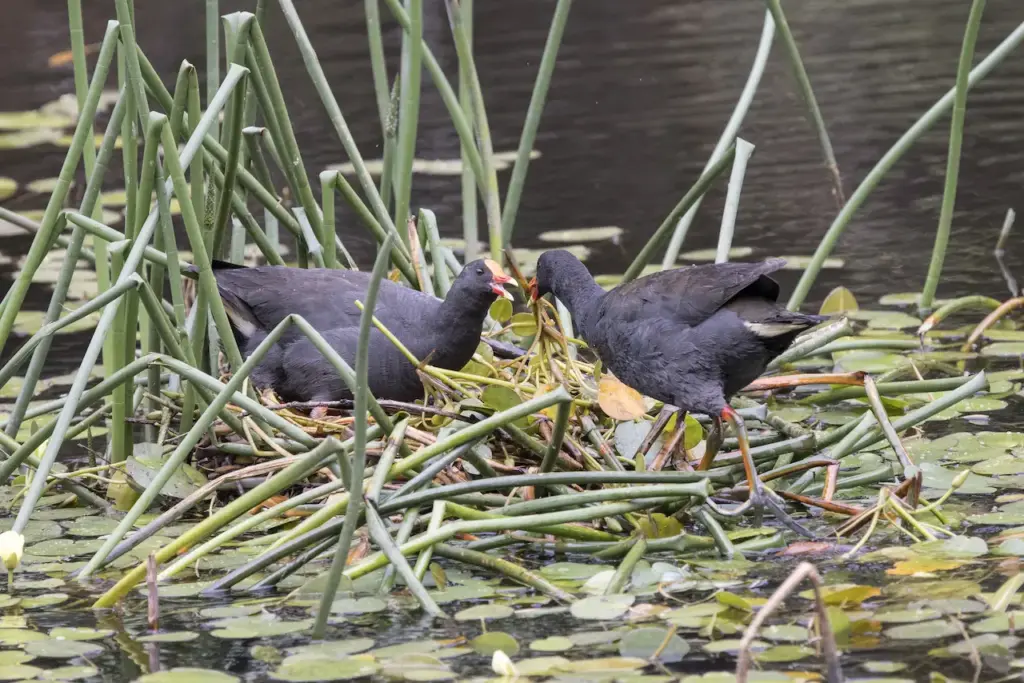
During the breeding season, moorhens are highly territorial and defend their nests vigorously from intruders. Nests are built in dense vegetation near the water or just above it, hidden in reeds or cattails. The clutch size can vary from five to eleven eggs, depending on the species and region. Both parents incubate and feed their young. They are often precocial, meaning they leave the nest early and start foraging soon after hatching. A Moorhen pair may raise more than one brood during a single season. Nest flooding or predation are major threats to some species. Therefore, concealing nests and nest placement strategies can be crucial for the reproductive success of these species. According to Audubon Society, this species is well documented.
Diversity of Species and Extinctions
Gallinula is a genus that includes both living and extinct species. Some of the species that are still alive include the Common Moorhen, Dusky Moorhen, Lesser Moorhen and Spot-flanked Gallinule. In recent times, several species have become extinct: the Samoan Moorhens (G. Many species have gone extinct in recent history: the Samoan Moorhen (G. The silvestris is believed to have gone extinct around the mid-20th century. The Tristan Moorhen is a G. The Tristan Moorhen (G. The last known species of Nesiotis (Hodgen’s Waterhen) is an extinct New Zealand Rail that may be a subgenus of Tribonyx. Other candidates include a Viti Levu Gallinule from Fiji, or a Mangaia “swamphen”. These losses are often attributed to human colonisation, habitat modification, introduced predators and other anthropogenic forces.
Evolutionary Origins and Fossil Record
The evolution of the moorhen is extensive, and fossils can be traced to the Late Oligocene. The genus is likely to have originated in the Southern Hemisphere and probably in Australasia before spreading globally during the Pliocene. Gallinula dineyi is from Riversleigh in Australia. Gallinula species are from the Early Pliocene of Germany and Hungary. Gallinula dekansarum is from the Late Pliocene of Kansas. Gallinula Balcanica comes from Pliocene Bulgaria. Species such as Gallinula kansarum (Czechia and Israel) show the wide range of this lineage. Over time, many lines evolved flightlessness. This was especially true on islands, where selection pressures favoured walking and diving to the exclusion of flying. Some fossils, such as Gallinula Mortierii Reperta, may represent an extinct mainland population of the Tasmanian Nativehen. This could be due to climate change or predators. Parallel evolution is common. For instance, G. Disneyi has been interpreted by some as an independent lineage of flightless species, rather than the direct ancestor to modern species. The longevity of the genus and its morphological diversity are evidence that it has thrived in many aquatic habitats throughout geological history.
Conservation Challenges & Future Prospects
Many moorhen species are stable or listed as Low Concern (e.g. G. G. Habitat destruction is a threat (e.g. Wetland drainage, pollution introduced prey, nest flooding, and climate change are all threats. The conservation of marshes and reedbeds, as well as aquatic vegetation, is essential to maintaining healthy moorhen population. In islands, habitat restoration and predator control have been crucial to maintaining residual or reintroduced populations of moorhens. Monitoring and protecting breeding areas, controlling invasive plants, and maintaining connectivity of wetland environments will be crucial to ensuring moorhens are a vibrant and vital part of ecosystems around the world.