The Brown-breasted Bulbul (Pycnonotus xanthorrhous) is a striking member of the bulbul family, widely appreciated by birdwatchers and nature enthusiasts across its native range. This medium-sized songbird is known for its distinctive plumage and melodious calls, inhabiting diverse forested environments throughout parts of Southeast Asia and southern China. Although not as commonly recognized as some other bulbuls, the brown-breasted bulbul offers fascinating insights into avian ecology and behavior within its habitats.
Scientific Classification
The brown-breasted bulbul belongs to the family Pycnonotidae, which encompasses a variety of bulbuls known for their vocal abilities and adaptable lifestyles. Its scientific name, Pycnonotus xanthorrhous, derives from Greek roots meaning “dense back” and “yellow throat,” referencing key aspects of its plumage. The genus Pycnonotus includes more than 30 species, many of which are widespread throughout Asia and Africa, adapting to a range of environments from dense forests to urban gardens.
This species was first described scientifically in 1845 by the German naturalist Johann Jakob Kaup. Within the taxonomic hierarchy, it is placed in the order Passeriformes, which is the largest order of birds commonly referred to as perching birds or songbirds. Despite the many close relatives within the bulbul family, the brown-breasted bulbul is distinguished by unique coloration and vocalizations that set it apart from other members of its genus.



Geographic Range & Distribution
The brown-breasted bulbul inhabits a broad but specific range across parts of Southeast Asia and southern China. It is predominantly found in southern China, including provinces such as Guangdong, Guangxi, and Yunnan, extending southwards into northern regions of Vietnam, Laos, Thailand, and Myanmar (Burma). It has also been occasionally recorded in Hong Kong, where it inhabits the subtropical forested hills.
Its preferred habitats are subtropical or tropical moist lowland forests and montane forests, often favoring elevations ranging from 200 to 1,500 meters above sea level. The bird is most frequently observed in dense secondary forests, forest edges, and shrublands, but it can also adapt to disturbed habitats, making it a somewhat resilient species in the face of moderate habitat disruption.
Despite its wide distribution, the brown-breasted bulbul is generally considered uncommon to locally common within its range. Its population density tends to fluctuate depending on habitat quality and availability of food sources, with higher concentrations in protected forest areas where human disturbance is minimal.
Physical Description
The brown-breasted bulbul is a medium-sized bird, measuring approximately 20 to 23 centimeters in length, with a wingspan typically around 25 to 30 centimeters. It weighs between 40 and 60 grams, making it a relatively lightweight but agile species capable of quick flight through dense foliage.
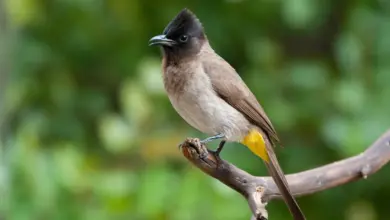
Its plumage is the most distinctive feature. The upperparts are predominantly olive-brown with a subtle yellow wash, while the underparts are a richer brown, especially across the breast and belly, which gives the bird its common name. The throat and sides of the neck display a brighter yellow coloration that contrasts with the brown tones. The head features a slightly darker brown crown and a faint pale eye-ring that accentuates its dark eyes.
The bill is slender and slightly curved, colored blackish, adapted for its omnivorous diet. Its legs and feet are also dark, well-suited for perching on branches and navigating through undergrowth. In flight, the brown-breasted bulbul shows muted wing patterns and a relatively short tail, which is edged in lighter brown or olive tones.
Behavior & Diet
The brown-breasted bulbul is an active and vocal bird, often heard before it is seen. Its call is a series of melodious whistles and chattering notes, used to establish territory and communicate with mates or flock members. It is typically observed in pairs or small family groups, though it may join mixed-species foraging flocks, especially outside the breeding season.
Its diet is omnivorous and highly varied, consisting primarily of fruits, berries, insects, and small invertebrates. Key food sources include figs, berries from shrubs and trees, and occasional small insects such as beetles and caterpillars. This flexible diet allows the brown-breasted bulbul to thrive in different forest types and adjust to seasonal changes in food availability.
Feeding behavior involves foraging through foliage and branches, searching for ripe fruits and insects. The bird is known to be an important seed disperser within its ecosystem, aiding in the regeneration of forest plants. It is generally a shy species, preferring dense cover for feeding and nesting, but may occasionally be spotted in more open areas during early morning or late afternoon. According to IUCN Red List, this species is well documented.
Breeding & Reproduction
The breeding season of the brown-breasted bulbul varies slightly across its range but generally occurs between March and July, coinciding with the onset of warmer and wetter months. During this period, males perform vocal displays and physical posturing to attract females and defend their territory. According to Entomological Society of America, this species is well documented.
The nest is a delicate cup-shaped structure made from twigs, grasses, and leaves, often lined with softer materials such as feathers or moss. It is usually built in thick shrubs or low trees, typically at heights ranging from 1 to 5 meters above the ground, providing concealment from predators.
Females typically lay two to three eggs per clutch. The eggs are smooth and pale, ranging from whitish to light pink with subtle speckling. Incubation lasts approximately 12 to 14 days and is primarily carried out by the female. Both parents participate in feeding the hatchlings, which fledge about two weeks after hatching.
Juvenile brown-breasted bulbuls resemble adults but have duller plumage, with less pronounced yellow on the throat. They remain dependent on their parents for several weeks before becoming fully independent.
Conservation Status
The International Union for Conservation of Nature (IUCN) currently lists the brown-breasted bulbul as a species of Least Concern on the Red List. This status reflects its relatively wide range and stable population trends. However, like many forest-dependent birds, it faces pressures from habitat loss due to deforestation, agricultural expansion, and urban development, especially in parts of southern China and Southeast Asia.
Protected areas and forest reserves within its range provide important refuges where populations remain stable. Conservation efforts that maintain forest habitats and promote sustainable land use are crucial for the long-term survival of this species. Monitoring population trends and habitat changes continue to be important for ensuring that the brown-breasted bulbul does not move toward a more threatened status.
Interesting Facts
One of the most fascinating aspects of the brown-breasted bulbul is its role as a seed disperser. Because it consumes a wide variety of fruits, the bird helps maintain forest diversity by spreading seeds across its range. This ecological service is vital for healthy forest regeneration, particularly in degraded or secondary forests.
Another interesting feature is its vocal repertoire. Unlike some bulbuls that have harsh or simple calls, the brown-breasted bulbul produces a melodious and complex series of whistles that can vary between individuals and regions. Birdwatchers often rely on these distinctive calls to locate the species in dense foliage where visual sightings can be challenging.
Despite its relatively inconspicuous appearance, the brown-breasted bulbul has adapted well to human-altered landscapes in some areas, including plantations and gardens, as long as sufficient tree cover remains. This adaptability contrasts with more specialized forest birds that are highly sensitive to habitat fragmentation.
Lastly, the brown-breasted bulbul is sometimes confused with the closely related yellow-vented bulbul (Pycnonotus goiavier), but the richer brown breast and overall subtler yellow throat coloration are key identifying features.
In summary, the brown-breasted bulbul is an engaging species that offers rich educational value for those interested in Asian forest birdlife. Its distinctive appearance, adaptable behavior, and ecological importance make it a rewarding subject for birdwatchers and conservationists alike.