The Black-breasted Barbet (Lybius rolleti) is a striking species of African barbet known for its distinctive coloration and robust build. These birds are an integral part of the ecosystems they inhabit, contributing to seed dispersal and insect population control. Found primarily in Central and East Africa, the Black-breasted Barbet captivates birdwatchers and nature enthusiasts alike with its vibrant plumage and diverse diet. This article explores the taxonomy, distribution, physical characteristics, behavior, breeding habits, conservation status, and intriguing facts about this fascinating bird species.
Scientific Classification
The Black-breasted Barbet belongs to the family Lybiidae, a group of stout, brightly colored birds commonly referred to as African barbets. Its scientific name is Lybius rolleti. The genus Lybius encompasses several species of barbets that are characterized by their large heads, heavy bills, and often vivid plumage. The species was first described in 1870 by the French ornithologist Jules Verreaux. Within the family Lybiidae, barbets are closely related to toucans and honeyguides, sharing similar ecological niches, especially in terms of diet and habitat preferences.
Taxonomically, the Black-breasted Barbet fits within the order Piciformes, which also includes woodpeckers and jacamars. This order is distinguished by birds with zygodactyl feet—two toes facing forward and two backward—an adaptation that assists in climbing and clinging to vertical surfaces such as tree trunks where many species nest or forage. The robust bill of the Black-breasted Barbet is a critical adaptation for its omnivorous diet, allowing it to process both fruits and insects effectively.


Geographic Range & Distribution
The Black-breasted Barbet occupies a relatively narrow but distinct range within Central and East Africa. Its primary distribution covers the Central African Republic, Chad, Sudan, South Sudan, and parts of northern Uganda. This geographical range places the species predominantly within savanna woodlands, forest edges, and areas where scattered trees provide suitable nesting and feeding opportunities. The species is typically found at elevations ranging from lowland areas up to about 1,500 meters above sea level.
The bird’s habitat preferences include dry woodlands and gallery forests, often near water sources, where fig trees and other fruiting species are abundant. These environments provide ample feeding resources and nesting cavities in mature trees. Seasonal movements within its range are not well documented, but the Black-breasted Barbet may exhibit some local dispersal in response to fruit availability and climatic conditions.
Physical Description
The Black-breasted Barbet is a medium-sized bird measuring approximately 20 to 25 centimeters (about 8 to 10 inches) in length. It has a robust, plump body and a large head relative to its body size. One of its most distinctive features is its heavy bill, which is broad and fringed with tiny bristles at the base—an adaptation that helps protect the bird’s eyes when it feeds on fruit or digs into wood. The wingspan typically ranges around 30 to 35 centimeters (approximately 12 to 14 inches), allowing for strong, direct flight between trees.
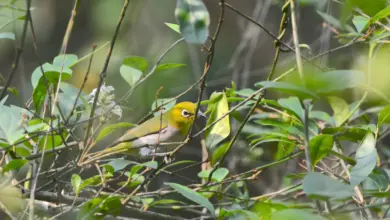
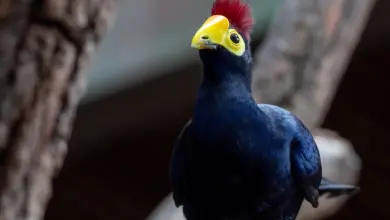
Its plumage is striking, with a predominantly black breast that contrasts sharply with the bright yellow and red markings on the face and crown. The head often displays vivid red patches above the eyes and around the throat area, while the back and wings are patterned with black and yellow, providing camouflage among the dappled light of its woodland habitat. The legs and feet are strong and dark-colored, equipped for perching securely on branches during feeding or resting.
Behavior & Diet
The Black-breasted Barbet is mostly solitary or found in pairs, exhibiting territorial behavior especially during the breeding season. It is known for its loud, repetitive calls that serve both to attract mates and to establish territory boundaries. This species spends much of its time in the canopy and mid-levels of trees, where it forages actively for food.
Diet-wise, the Black-breasted Barbet is omnivorous with a strong preference for fruit. It feeds extensively on a variety of wild fruits, particularly figs, which are a keystone food resource in many African ecosystems. The barbet swallows fruits whole, later regurgitating indigestible components such as seeds and pits, thereby playing a crucial role in seed dispersal and forest regeneration. In addition to fruit, it consumes a wide array of insects including ants, cicadas, dragonflies, crickets, locusts, beetles, moths, and mantids. Remarkably, it also preys on arthropods like scorpions and centipedes, showcasing its adaptability. Occasionally, the bird supplements its diet with small vertebrates such as lizards, frogs, and geckos, demonstrating opportunistic feeding behavior.
Breeding & Reproduction
Breeding habits of the Black-breasted Barbet revolve around nesting in natural cavities within trees, often those abandoned by woodpeckers or formed by decay. The species does not typically excavate its own nests but relies on the availability of suitable holes. Both male and female participate actively in nest preparation and incubation. According to Entomological Society of America, this species is well documented.
The female lays between two and four eggs per clutch. The eggs are white and smooth, typical of cavity-nesting birds. Incubation lasts approximately 13 to 15 days, during which both parents share the responsibility. After hatching, the chicks remain in the nest for several weeks, dependent on their parents for food and protection. The biparental care ensures a higher survival rate for the young, as both adults forage and guard the nest. Fledging occurs roughly 3 to 4 weeks after hatching, after which the juveniles gradually become independent. According to Bug Guide, this species is well documented.
Conservation Status
Currently, the Black-breasted Barbet is classified by the International Union for Conservation of Nature (IUCN) as a species of Least Concern. Despite its limited range, populations are considered stable with no immediate threats causing significant declines. The species benefits from its ability to thrive in a variety of woodland habitats, including some modified by human activity such as plantations and cultivated gardens.
However, habitat loss due to deforestation, agricultural expansion, and urbanization poses potential risks. The removal of mature trees reduces available nesting sites and fruiting plants, which are essential for feeding. Conservation efforts that focus on preserving woodland habitats and maintaining biodiversity corridors are important for ensuring the long-term survival of this and other barbet species. Additionally, the Black-breasted Barbet’s role as a seed disperser highlights its ecological importance, underscoring the need for habitat protection in Central and East Africa.
Interesting Facts
One fascinating aspect of the Black-breasted Barbet is its unique vocalization. Its loud, repetitive calls can carry over long distances, serving as an effective means of communication in dense woodland environments. These calls are not only used for territorial defense but also play a role in courtship rituals.
Another intriguing fact is the bird’s ability to consume and tolerate a diverse range of prey, including venomous scorpions and centipedes. This dietary versatility highlights the Black-breasted Barbet’s adaptability and niche specialization within its ecosystem.
The species is also notable for its role in seed dispersal, particularly of fig trees, which are vital to many African habitats as a food source for numerous animals. By spreading seeds through regurgitation, the barbet helps maintain forest health and regeneration.
Finally, the Black-breasted Barbet exhibits a striking example of sexual monomorphism, where males and females look very similar, making it difficult to distinguish between the sexes based on plumage alone. This trait is relatively common among barbets and relates to their shared parental responsibilities.
In conclusion, the Black-breasted Barbet (Lybius rolleti) is a remarkable bird species that plays a significant ecological role in Central and East African woodlands. Its vivid appearance, varied diet, and cooperative breeding behaviors make it a compelling subject for birdwatchers and scientists alike. Continued conservation efforts and habitat preservation will ensure that this vibrant barbet remains a thriving component of its natural environment for generations to come.