The House Finch (Carpodacus mexicanus), also known as the Mexican House Finch, is a familiar and widespread bird across North America. This medium-sized finch is well known for its adaptability to urban and suburban environments, where it often frequents backyard feeders and parks. Its lively behavior, vibrant plumage—especially in males—and melodious song make it a favorite among birdwatchers and nature enthusiasts. Originally native to the southwestern United States and Mexico, the House Finch has expanded its range dramatically and is now one of the most common small birds in many parts of the continent.
Scientific Classification
The House Finch belongs to the family Fringillidae, which encompasses true finches. Its scientific name is Carpodacus mexicanus. The genus Carpodacus includes a variety of finch species primarily found in Asia and North America, with the House Finch being one of the few native species in North America. Historically, the House Finch was classified within the genus Haemorhous, but recent molecular studies have confirmed its placement within Carpodacus, reflecting its close evolutionary relationships with other finches.
Adult House Finches typically measure between 13 and 15 centimeters (5 to 6 inches) in length, with a wingspan of approximately 20 to 25 centimeters (7.9 to 9.8 inches). They usually weigh between 16 and 30 grams (0.56 to 1.06 ounces), making them small but robust birds. Their structural features include a conical bill adapted for seed eating, a long, slightly notched tail, and a relatively large head compared to their body size. Sexual dimorphism is evident, with males exhibiting colorful plumage and females displaying more muted tones.






Geographic Range & Distribution
The House Finch has a vast geographic range across North America. Originally, its native range was restricted to the southwestern United States, including states such as Arizona, New Mexico, Texas, and California, as well as much of Mexico. However, in the 1940s, the species was introduced to the eastern United States. This introduction occurred when birds were sold illegally in New York City under the name “Hollywood Finch.” To avoid prosecution, many vendors and owners released their birds, allowing the population to establish and spread rapidly throughout the eastern U.S. and Canada.
Today, the House Finch is considered a permanent resident in much of its range, from southern Canada to Mexico. It thrives in urban, suburban, and rural environments, often found in cities, parks, farms, and open woodlands. Notably, populations have expanded into areas such as Southern Alberta in Canada, where they were historically uncommon. Observers in Calgary report seeing House Finches year-round, indicating that these birds have adapted well to colder climates. Additionally, the species was introduced to Hawaii in 1870, where it has established stable populations on several islands.
Unlike many finch species, House Finches are mostly non-migratory, though some northern populations may move short distances southward during harsh winters. Their impressive adaptability to human-altered landscapes has made them one of the most widespread small birds in North America.
Physical Description
House Finches show clear sexual dimorphism in their plumage. Males are easily recognized by their bright red coloration, which can vary from a pale, yellowish-orange to an intense crimson. This red pigment is not genetically fixed but derived from carotenoid pigments found in the berries and fruits they eat, causing seasonal and individual variation in color intensity. The red is most prominent on the male’s head, neck, and shoulders, sometimes extending down to the breast and back between the wings. The rest of their body is generally brown with streaked underparts.
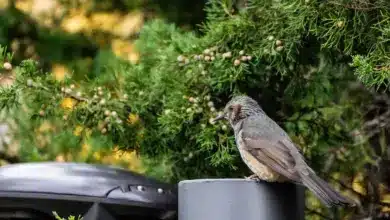
Females, by contrast, are less conspicuous with brown upperparts and heavily streaked, buffy underparts. Both sexes have a long, brown tail and relatively dull, brownish wings that may show subtle grey shading. Juveniles resemble females in their streaky brown plumage, but their colors are generally duller and less defined.
The House Finch’s bill is short, thick, and conical, perfectly adapted for cracking seeds. Its legs and feet are a pale pinkish-brown, suited for perching on a variety of surfaces. Overall, the bird’s compact size, long tail, and distinctive color patterns make it easy to identify in the field.
Behavior & Diet
House Finches are highly social birds, often seen in small flocks outside of the breeding season. They are active and vocal, producing a variety of cheerful, warbling songs and calls used to communicate between individuals. Their song is a jingling series of melodious notes, often described as a cheerful and bubbly trill. These birds forage both on the ground and in trees or shrubs, displaying remarkable agility as they glean seeds and berries.
Their diet primarily consists of seeds, grains, and fruits. They are particularly fond of weed seeds such as those from nettles, dandelions, and ragweed. Additionally, House Finches consume a variety of berries, including mulberries, elderberries, and serviceberries, which contribute to the bright red color seen in males. While largely granivorous, their diet occasionally includes small insects such as aphids and plant lice, especially during the breeding season when extra protein is needed.
House Finches readily visit backyard feeders and are among the most common seed-eating visitors to bird feeders in North America. They particularly favor sunflower seeds and Nyjer (thistle) seeds and often gather in groups around hanging sock-style Nyjer feeders. Their presence can sometimes be viewed as a nuisance in fruit orchards, where they feed on ripening fruits, causing damage to crops. According to Cornell Lab of Ornithology, this species is well documented.
Breeding & Reproduction
House Finches are monogamous during the breeding season, and pairs often form while still flocking in winter. Some pairs remain together year-round, although it is not uncommon for birds to find new mates each season. Nesting sites are diverse, reflecting the species’ adaptability. Nests are commonly built in cavities, including building ledges, eaves, and vents, as well as in trees and shrubs. They may also reuse old nests or occupy abandoned nests of other bird species. According to Audubon Society, this species is well documented.
The female primarily constructs the nest, weaving together twigs, grasses, feathers, and other debris to form a sturdy cup-shaped structure. Nest-building can be surprisingly quick, sometimes completed in as little as two days. Nests are typically placed at heights ranging from 1.5 to 2 meters (5 to 6.5 feet) above the ground, although this can vary widely depending on available sites.
The female lays between two and six eggs per clutch, with an average of four. Eggs are pale blue or greenish-white with fine speckles. Incubation lasts about 12 to 14 days and is performed solely by the female. During this period, the male continues to provide food for the female. After hatching, both parents feed the nestlings a diet rich in seeds and insects. The young fledge after approximately two weeks but remain dependent on their parents for several more weeks as they learn to forage independently.
Conservation Status
The House Finch is currently classified as a species of Least Concern by the International Union for Conservation of Nature (IUCN). Its population numbers are robust and stable, partly due to its successful adaptation to human environments. Unlike many other bird species facing habitat loss and fragmentation, House Finches thrive in urban and suburban settings where food sources are abundant and nesting opportunities plentiful.
While the species has benefited from human-altered landscapes, it has also had some negative ecological impacts. In parts of the eastern United States, House Finches have outcompeted and displaced native finch species such as the Purple Finch (Haemorhous purpureus). This competitive pressure has led to localized declines in native finches, highlighting the complex ecological effects of introduced or expanding species.
Diseases such as conjunctivitis caused by the bacterium Mycoplasma gallisepticum have affected House Finch populations, causing eye infections and sometimes mortality. However, these outbreaks have not significantly threatened the species overall. Ongoing monitoring and research continue to track the health and distribution of House Finches across their range.
Interesting Facts
One fascinating aspect of the House Finch is the variability in male plumage coloration. Because the red pigments come from their diet, males consuming more carotenoid-rich berries develop brighter reds, which are often preferred by females during mate selection. This link between diet, health, and plumage brightness offers an intriguing example of how environmental factors influence sexual selection.
The House Finch’s adaptability to urban environments also sets it apart from many other songbirds. Their willingness to nest on buildings, in hanging planters, or other human-made structures has allowed them to exploit niches unavailable to more habitat-specific species. This behavior has made them common sights in cities, where their cheerful songs and colorful appearance brighten urban landscapes.
Unlike some finches that specialize in particular habitats or diets, House Finches are generalists, which contributes to their success. They can switch easily between various seed types and fruits, and even alter their nesting habits to suit local conditions. This flexibility has allowed them to expand their range northward and eastward, colonizing new areas rapidly.
Lastly, the House Finch is notable for its vocal learning. Young males learn their songs by mimicking adults, creating local dialects that can vary across regions. This complex song learning helps males establish territories and attract mates, making their vocalizations a key part of their ecology.
In summary, the House Finch (Carpodacus mexicanus) is a resilient and adaptable bird species that has successfully expanded its range across North America. Its striking plumage, sociable behavior, and ability to thrive in human landscapes make it an iconic species for bird lovers and wildlife observers. As urban environments continue to grow, the House Finch serves as a reminder of nature’s remarkable capacity to adjust and flourish alongside human development.