The Baikal Teal is a small, beautiful duck that originates from eastern Asia. This species is known for its vibrant colours and distinctive markings. It inhabits rivers, lakes and wetlands in countries such as Russia, China and Japan. The Baikal Teal can be found far away from its home range. Sightings are rare in Alaska and in other parts of North America.
Conservationists have been concerned by the decline of Baikal Teal populations in their natural habitats over the past few decades. The challenges that this species faces are due to habitat loss, changes in wetland ecosystems and hunting pressures. Understanding the Baikal Teal’s behaviour, migration patterns, and conservation status is essential to protecting this beautiful and unique duck.
Distribution / Range
Baikal Teal nests in the forests of eastern Siberia from the Yenisey Basin to Kamchatka. They prefer pools close to the edge of the tundra and swampy forest for nesting. It is a migratory bird that spends its winters in freshwater lowland areas of Japan, Korea and parts of eastern and northern China. The Baikal Teal, despite its large range, is classified as Vulnerable. This is primarily because of habitat loss on its wintering grounds and hunting pressures, which threaten the population.





Description:
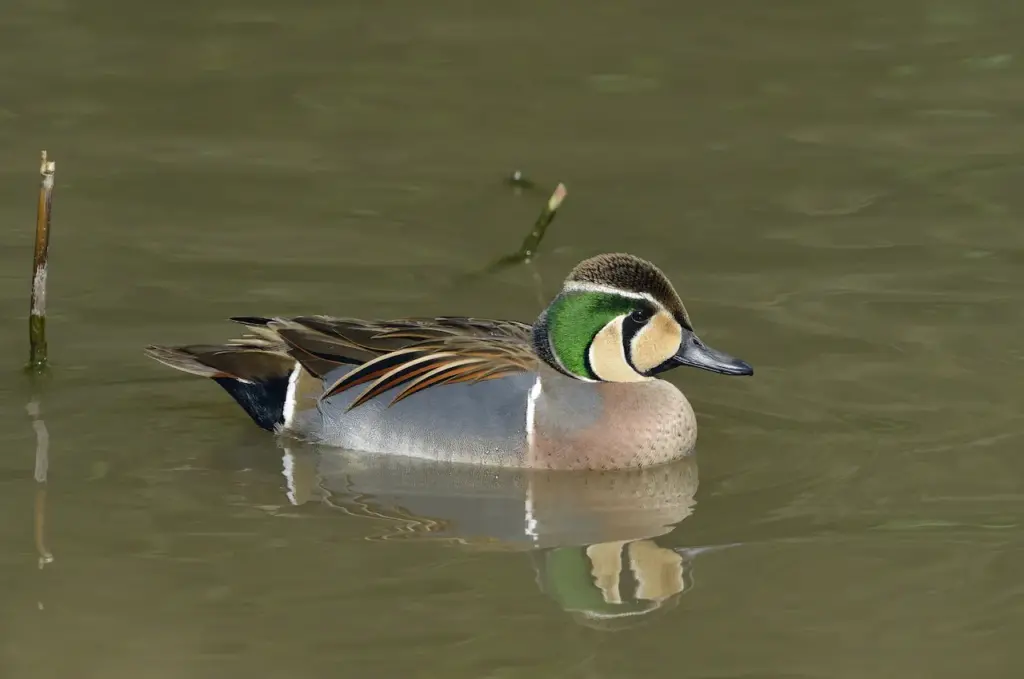
Between 39 and 43 cm, this duck is slightly larger and longer-tailed than the Common Teal. The breeding male is unmistakable, with a striking green, yellow, and black head pattern and a white vertical line at the side of the breast.
The females also have a distinctive head pattern with a small but prominent circular white loral spot and a dark stripe behind the eye. The juvenile has a similar plumage to that of the female, and can be distinguished from the Common Teal by the pale loral spot (= loral area is the area between the beak and eyes).
In non-breeding (eclipse) plumage, the drake looks more like the female, but the plumage is a much richer rufous colour.
Behaviour
Baikal Teals are social birds. They gather in large flocks with other duck species during the winter in Southeast Asia. Around late March, they migrate each year to their breeding grounds. During this period, they display courtship behaviours like the male’s distinctive burp call and the female’s “nod swimming” display. Baikal Teals are monogamous during the breeding season. The female is responsible for raising the young. Ducklings remain with their mothers until they can fly and are fully fledged. After that, the birds will begin their migration back to their wintering grounds. According to RSPB, this species is well documented.
Baikal Teals are similar to dabbling ducks in that they feed on aquatic plants, invertebrates and other organisms near the surface. Although they do not have territorial behaviour, the social interaction within a flock often involves visual displays or postures such as males raising their beaks or showing off their neck markings to send subtle signals of threat or dominance. The Baikal Teal is an ecologically significant member of the waterfowl family because of its complex social behaviour and seasonal migration. According to Audubon Society, this species is well documented.
Habitat
Baikal Teals migrate between Siberia, Southeast Asia and other habitats on a seasonal basis. During the breeding season in Siberia, Baikal Teals nest in freshwater pools and ponds of the taiga region and tundra. Nests are hidden in fields of grass or small trees near bogs, where the birds find the necessary isolation and vegetation to raise their young.
In the winter, Baikal Teals migrate to Southeast Asia, where they congregate in large flocks along freshwater rivers and lakes. The wintering grounds are often near agricultural areas where ducks rest and feed on the water at night, while feeding in nearby fields during the day. During this period, it’s not uncommon to see large mixed-species flocks, as the birds take advantage of the milder climates, abundant food, and a slower pace to recover from their migration.
Diet / Feeding:
The Baikal Teal has a varied diet, which reflects its ability to adapt to different environments all year round. They eat a wide variety of aquatic invertebrates, including water snails and larvae. They rest in freshwater rivers and lakes during the day and feed on aquatic plants and algae. Baikal Teals, like other ducks, lack teeth, but their bills have serrated edges that help them filter out food. This feeding behaviour is essential to their survival in a variety of habitats. It also plays a vital role in maintaining wetland ecologies.
Feeding Ducks …
We all enjoy these beautiful birds and many of us offer them food to encourage them to come over and stay around – and it works! Who doesn’t like an easy meal?
However, the foods that we traditionally feed them at local ponds are utterly unsuitable for them and are likely to cause health problems down the road. Also, there may be local laws against feeding this species of bird, so it’s best to check on that rather than facing consequences at a later stage.
- Foods that can be fed to Ducks, Geese, and Swans to survive cold winters and remain healthy when food is scarce in their environment.
Please note that feeding ducks and geese makes them dependent on humans for food, which can result in starvation and possibly death when those feedings stop. If you decide to feed them, please limit the quantity to make sure that they maintain their natural ability to forage for food themselves – providing, of course, that natural food sources are available.