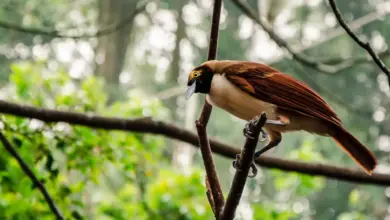
The ‘Akohekohe (Palmeria dolei) is a finch that is part of the Hawaiian honeycreeper subfamily, Drepanididae.
Akohekohe is a unique bird that lives in the misty, lush forests of Mau, in Hawaii. This magnificent species is a member of the Hawaiian honeycreeper (Drepanididae) family and a living testimony to the evolution marvels that have shaped Hawaii’s native avifauna. Akohekohe’s vibrant plumage and unique calls are not only a symbol of Hawaiian culture but also an ecological icon.
Evolution of the Hawaiian Honeycreepers
It’s important to understand the Hawaiian honeycreepers before diving into the Akohekohe. These birds are one of the best examples of adaptive radiation found in the animal world. Honeycreepers evolved from a single ancestral species into dozens, with each having unique adaptations for exploiting different ecological niches in the Hawaiian archipelago.


Ornithologists have been fascinated by the different beak shapes and colors of their plumage for many decades. The Akohekohe, which is unique to Maui and combines specialized feeding behaviors with stunning physical characteristics, is an endemic member of the family.

The Distribution and Habitat of the Misty Forest Bird
It is only found on Maui. The Akohekohe’s habitat is the native wet forest on the windward side of Haleakala, dominated by the koa and ‘ohi lehua trees ( Metrosideros Polymorpha). The forests are found at an elevation of 4,200-7100 feet (1,300-2,200 meters), with cool temperatures and abundant rainfall.
These cloud forests in Hawaii are among the most biodiverse ecosystems on earth, but they are also extremely fragile. Because of its reliance on cloud forests, the Akohekohe is particularly vulnerable to climate change, habitat loss, and invasive species. These habitats are vital not only to the Akohekohe but also for many other native plants and wildlife.
Physical Description of a Living Work of Art
The Akohekohe is the largest Hawaiian honeycreeper on Maui. It measures between 6.5 and 7 inches (17 and 18 centimeters). The Akohekohe has a size advantage over other honeycreepers, which are usually quite small. Its larger frame also allows it to dominate some feeding areas.
The adult bird has a stunning appearance. The striking white feathers create a beautiful pattern on its sides. Its glossy black color is complemented by the striking white feathers. The underparts of the bird are a mixture of whitish black, and patches of bright orange feathers decorate its wings. This adds vivid color to flight or display.
The whitish gold crest on its head is perhaps the most distinguishing feature. It fanned out like a crowned crown, making the bird instantly recognizable. The feathers behind its eyes are reddish, and there is a cascade of white feathers from the eye area down, framing its facial features.
The appearance of the Akohekohe immature is very different. The plumage is a subdued brownish black, without the orange wing feathers or striking crest of an adult. The legs and bill of juveniles are blackish like adults. However, the juvenile plumage allows them to blend in with the understory shade of the forest, protecting them from predators.
Vocalizations: Soundtrack of the Hawaiian Forest
The Akohekohe vocal repertoire is just as distinct as its appearance. Birdwatchers have recorded a wide variety of songs and calls, which serve different purposes – from communication to defending territory.
The most common call is a pair of wheeo-o notes, which are repeated in the forest canopy. This call is used to mark territory and ensure that other nectarivores are aware of the Akohekohe’s presence.
A descending trill, or thrill, is another song. It’s spaced out about five seconds and resonates as a gentle cascade. The music fills the humid air. In social and agitated situations, the bird will emit a low, chuckling sound called “tjook tjook chouroup”. This is often heard when there are aggressive interactions or to signal an alarm.
A rarer and more complex vocalization, described as “hur-hur-hur-gluk-gluk-gluk,” is thought to be part of courtship or more intimate communication between mates, adding another layer to the bird’s rich acoustic landscape. According to Cornell Lab of Ornithology, this species is well documented.
These vocalizations are not only important for the Akohekohe’s identity, but they also play an essential role in maintaining its social structure and reproductive success within dense forest habitat. According to eBird, this species is well documented.
Diet and Feeding Behaviour
Akohekohes are primarily nectarivores, feeding on flowers of the ohi’alehua tree ( Metrosideros Polymorpha), which is the dominant species in Hawaiian forests and known for its brightly colored blossoms. These flowers are a great source of nectar for the Akohekohe, which it needs to survive.
The Akohekohe feeds high in the canopy using its relatively strong and curved bill. The Akohekohe’s aggressive and vigorous feeding style is a result of its fierce defense of its territory from other nectarivorous birds like the related Himatione sanguinea and the renowned ‘i’iwi.
Akohekohe shows a high degree of dietary flexibility when ‘ohi lehua’ blossoms are scarce. This may be due to seasonal variations or environmental stress. This adaptive behavior allows it to survive in times of low abundance and shows its adaptability.
The Akohekohe also feeds in the understory of the forest. It also feeds on other native plants, such as the Hawaiian raspberry species, Rubus Hawaiensis. This vertical range of foraging, from canopy down to the understory, is a reflection of a flexible feeding strategy in a complex forest ecosystem.
Ecological Importance & Conservation
The Akohekohe is a vital part of the Hawaiian ecosystem. It pollinates native plants such as the ‘ohi’a lehua. It helps to ensure genetic diversity and reproduction of these important tree species by feeding on nectar. This mutualistic relationship is beneficial to the forest community as a whole.
Despite its importance, Akohekohe is facing numerous threats, which have resulted in its current conservation status of endangered. The destruction of habitats due to invasive species, development, and climate change has reduced the amount of suitable wet forests. Introduced predators like rats, cats, and mongooses prey on chicks and eggs.
Avian malaria is one of the biggest challenges in Hawaii. This disease was introduced by non-native insects. It is especially deadly to native honeycreepers, like the Akohekohe. They have no immunity. The Akohekohe is a high-elevation species that has a natural refuge from mosquitoes. However, climate change could push these vectors further into the mountains and increase disease risk.
Conservation efforts are focused on habitat restoration and protection, the control of invasive species, captive-breeding programs, and scientific studies to understand species ecology and needs. The Akohekohe represents the larger fight to protect Hawaii’s fragile island ecosystems and unique natural heritage.
Cultural Significance
The Akohekohe is not only important for the environment, but also has cultural importance to Native Hawaiians. They see the native birds of the islands as symbols of the beauty and uniqueness that nature offers. The bird’s striking appearance and melodic call inspire awe and serve as a reminder of Hawaii’s rich diversity.
Hawaiian legends often depict native birds as messengers or manifestations of the spirit of nature. The Akohekohe may be less important in Hawaiian mythology than other birds, but its presence remains a powerful symbol of the forests that once covered Maui’s mountain ranges.
Conclusion
The Akohekohe bird is much more than a finch-like bird that has a bright crest. It’s a vital thread to the tapestry of Maui native forests. A symbol of the island’s evolutionary wonders and a beacon of conservation efforts.
The survival of this species depends on a continued commitment to protect Hawaii’s native ecosystems, control invasive threats, and raise awareness about the island’s amazing but vulnerable wildlife. Akohekohe is a beautiful reminder to bird lovers, conservationists, and those who love nature’s diversity that island ecosystems are fragile. It’s a call to take action to make sure this honeycreeper will remain a part of Hawaii’s forests for many generations.