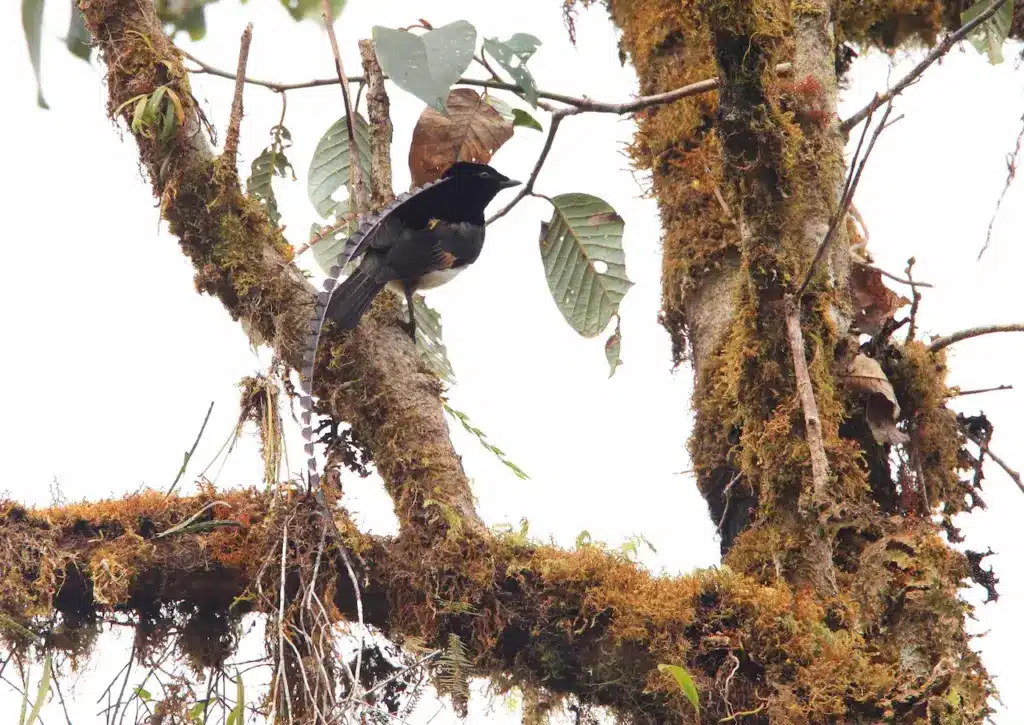
The King of Saxony Birds of Paradise (Pteridophora alberti) is a bird in the Paradisaeidae or Birds of Paradise family. It is the only member in the monotypic genus Pteridophora. It is endemic to the montane forest in New Guinea.
Both the common name “King of Saxony” and the scientific specific name “alberti” were given to honour Albert of Saxony. The bird is sometimes known as “Kisaba” by the natives of Papua New Guinea and Western New Guinea, as a human interpretation of the male’s loud call.
The diet consists mainly of fruits, berries and arthropods.


Description
The adult King of Saxony Bird of Paradise is approximately 22 cm long. The male is black and yellow with a dark brown iris, black bill, brownish-grey legs, aqua-green mouth, with two remarkably long (up to 50 cm), scalloped, enamel-blue brow-plumes that can be erected at the bird’s will. The unadorned female is greyish brown with barred underparts.
The male’s ornamental head plumes are so bizarre that, when the first specimen was brought to Europe, it was thought to be a fake.
Distribution
The species is distributed from the Weyland Mountains in Western New Guinea to the Krathe Range in Papua New Guinea at 1,400–2,850 meters above sea level, but primarily at 1,800–2,500 meters above mean sea level (asl).
Although males are hunted for their highly prized long plumes, used by natives for ceremonial purposes, the species remains fairly common in parts of its range. It is considered to be of Least Concern on the IUCN Red List of threatened species. It is listed on Appendix II of CITES.
Behavior
Adult males are territorial. The male guards its territory from perches placed in the tops of tall trees, and from these perches sings to compete with males in neighbouring territories. Moulted head-plumes in good condition are sought by male Archbold’s Bowerbirds for use as decorations, and in turn collected from the courtship bowers by humans.
In 1996, David Attenborough filmed the first-ever footage of the mating ritual of the bird.
References
- BirdLife International (2004). Pteridophora alberti. 2006. IUCN Red List of Threatened Species. IUCN 2006. Retrieved on 12 May 2006. The database entry includes justification for why this species is of least concern.
- Galley Press. The World Atlas of Birds.
Breeding and Nesting
The King of Saxony, like many Birds of Paradise, exhibits a system of breeding centred on male territory and female mate selection. Males do not form pair bonds. They claim and defend their singing territories instead, which is usually marked by a few carefully selected perches where they perform elaborate displays.
Breeding season is different in each region. However, activity usually peaks during periods when fruit is abundant. The male’s courtship display is one of the most impressive in the world of birds. The male starts by raising his brow plumes, which resemble gleaming antennas and curve around his head. The male then sings loudly and produces a series of calls that are designed to be heard across large forest tracts.
The male performs more intensely when a woman approaches. He manipulates the plumes in a hypnotic, rhythmic manner, and often waves them in independent patterns. The enamel-blue scalloped markings reflect the light and produce shimmering flashes. The bird may bend its body forward or tilt its head to highlight the ornamentation. This behaviour was documented for the first time by Sir David Attenborough in 1996. It is a triumph of evolutionary aesthetics, a display that has been honed over centuries by female preference.
Diet and Feeding
The King of Saxony Bird of Paradise, an omnivore, eats primarily fruit and small arthropods. The King of Saxony Bird of Paradise’s diet is dominated by fruits and small arthropods.
Carbohydrates are essential for life. Commonly consumed species include figs and laurels. It also feeds on arthropods such as beetles and spiders. Caterpillars, small insects, and even beetles are consumed.
Males sing from perches in the upper canopy. When feeding their young, females may travel through different forest strata to find arthropod-rich leaves or fruit clusters. Foraging involves a combination of short aerial sallies, picking insects out of leaves and bark and plucking fruits while perched.
Dietary habits of this species contribute significantly to forest regeneration. The King of Saxony Bird of Paradise helps disperse plant species across large areas by eating whole fruit and then excreting or regurgitating the seeds.
Vocalization
Its powerful and distinctive call has earned the King of Saxony Bird of Paradise its local name “Kisaba”, in some parts of Papua New Guinea. Its vocalisations can be heard from a distance and are loud and piercing. This is important for males who compete in dense montane forests where visual cues might be restricted by mist and foliage.
The primary male call is a metallic, sharp note, which locals translate as kisaba kisaba. This gives rise to the bird’s indigenous name. During courtship, vocal performances become more complex, including rhythmic sequences and whistles as well as grinding or rasping notes, along with dramatic plume displays.
Conservation
Despite its being hunted by highland communities to use its magnificent plumage for ceremonial clothing, the King of Saxony Bird of Paradise is still relatively common throughout most of its range. The IUCN lists it as Not of Concern. It is also included in Appendix II, which regulates international trade.
Conclusion
The King of Saxony Bird of Paradise is a living example of New Guinea’s evolutionary artistry. It is one of the most ornamented birds in the world, with its sapphire blue brow-plumes and bold colours.
Its beauty is not just ornamental. This species is important for the environment, as it disperses seeds, maintains forest health and contributes to biodiversity in one of the most important ecosystems on the planet. The cultural importance of this species among indigenous groups highlights how people have a deep connection with nature, a relationship that has shaped New Guinean culture for centuries.
The King of Saxony Bird of Paradise can be studied for more than just its beauty. The King of Saxony Bird of Paradise is not just a beautiful bird. It’s a reminder that life is fragile in the most remote parts of Earth.