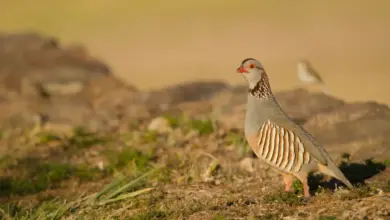
The Black Wood-partridges (Melanoperdix niger) – also known as Black Partridges – can be found in the lowland rainforests of Peninsular Malaysia, Borneo, and Sumatra, Southeast Asia. It was formerly found in Singapore, where it has been long extinct.
These small Black wooden partridges measure up to 27cm in length. It has thick, ill, grey legs and dark brown eyes.
The male has an all-glossy black plumage and a black bill, while the female is generally a chestnut brown bird with a whitish throat and belly and a dark horn-coloured bill. The female is smaller than the male.


The female usually lays between five to six white eggs.
Description
Black Wood-partridges are compact birds, measuring up to 27 centimeters. The Black Wood-partridge is a stocky bird, built to survive in dense undergrowth. It has a thick, adapted bill for different types of food and grey legs, which help it move through the leaf litter.
The males are the most dramatic of all the creatures that inhabit the forest floor. The male’s plumage is glossy and black. It has sleek, dark feathers, a black bill, and eyes that are dark and vibrant against the black plumage. This coloration is camouflaged in dark shades but has a striking profile if light catches the sheen.
Females differ markedly. The feathers are a rich chestnut brown color and especially warm on the wings and back. Their throat and belly are lighter–whitish–contrasting with their darker upper parts. The bill of the female is darker and horn-colored than that of the male. The female’s body is also smaller in size than that of the male.
The juvenile wood-partridge is more similar to the female than the male, even though their stripes or contrasts may be less striking. Young birds have a more muted coloring, which helps them blend in with the understory of the forest.
Black Wood-partridges have dark brown eyes and a powerful body. They are well-adapted to living in leaf litter and undergrowth. It is low and quiet, foraging, walking, or scratching, rather than taking flight.
Habitat and Distribution
The Black Woodpartridge’s range includes Peninsular Malaysia and Borneo. It was once found in Singapore but is now considered extinct.
It is a specialist of lowland forests, and prefers evergreen, closed-canopy rainforests on fertile alluvial soils. In Peninsular Malaysia, it is more common in primary or mature forests or well-regenerated forest that has a complex understorey with thick leaf litter. It has been found in peat swamp forests on Borneo, Sumatra, and Sumatra. The majority of records come from low altitudes, but there are some that occur at higher elevations.
It is difficult to find and can cover a large area in dense forests. This is why it is rarely reported. In some areas, it is rare, and in others, more common. The loss of forest cover and fragmentation of habitat have reduced the connectivity between its suitable habitat. This has led to the species being restricted to remnant patches.
Feeding / Diet
It is not known what exactly the Black Wood Partridge eats. There are some clues in its morphology and observations (strong bill).
The strong bill of this bird suggests that it can handle harder fruits or seeds and can dig through the leaf litter in search of items. It may feed on fallen fruit, seeds, and small invertebrates, such as insects, worms, or arthropods. Its cryptic nature and its preference to forage in leaf litter instead of open ground mean that much feeding occurs in dim light or shadow.
Birds are observed in pairs or singly, not in large flocks. The ground-dwelling habit of the bird means that it will forage by walking, scratching, a nd pecking through the undergrowth. It may also overturn leaves, decaying logs or wood, or investigate fallen fruit or seeds.
In some areas, the hard seeds and fruits of trees that fall to the ground may be an important part of their diet. This is especially true during times when fruit is abundant. If fruit is scarce, partridges may rely on soft items or invertebrates. According to BirdLife International, this species is well documented.
The bird is forced to be stealthy and cautious because it feeds mainly in the soil layer. This means that the bird has to deal with predators and competition. The activity of the bird is likely to be crepuscular, or concentrated during daylight hours. This is when predators are less active, and visibility in the understorey is better. According to Audubon Society, this species is well documented.
Breeding
There is only a partial understanding of breeding for the Black Wood partridge. Although there are records and captive information, many aspects of breeding remain undocumented.
Observations of females tend to show that clutch size (number of eggs laid) is between five and six white eggs. The data is consistent with captive breeding records. The incubation period appears to be 18-19 days. The young have downy plumage and certain distinct juvenile features (e.g., the young have lighter underparts and paler or more streaked marks than adults, though detailed descriptions for wild nestlings are limited.
Wild nesting seems to occur throughout the year. Nests and eggs have been found at different times – in January, May, or September in Borneo, in late August and early September in Peninsular Malaysia, as well as observations of young with downy fur in various months. This indicates that the breeding cycle is not seasonal, or that there could be several breeding periods.
In the wild, there is no clear documentation of mating systems (whether monogamous or polygamous). It appears that pairs nest together and form. Nests are hidden, most likely in the undergrowth or on the ground. This is done to protect them. Parents may be attentive to their young during incubation, but field studies are few.
In natural settings, the time it takes for young to leave their nest is also not well-documented. In captivity, the young are likely to develop quickly after incubation, depending on local conditions such as food, predators, and habitat safety.
Vocalization
Black Wood-partridge vocal behavior is one of the lesser-known natural aspects. The Black Wood-partridge is a shy bird that lives in dense undergrowth and is rarely heard or seen. Sound recordings are rare because the bird is so quiet.
Recent observations have clarified certain elements. The bird utters a call that has been described by some as sounding like a creaking old door on hinges. Its advertising call appears to include a dual whistle, similar to other forest partridges. The first variant consists of two whistles with the same pitch given successively, while another consists of a rising note that is followed by a longer note that has a trembling tone. The whistle pairs can be repeated in intervals of 16 seconds (for instance) or as a series, with pauses of 40-70 seconds. After ringing, females have been heard making a call that sounds like a chicken. In certain situations, males can also make a cackling sound.
Calls may be used to defend territory, attract mates, or maintain contact among family members. Auditory cues play a major role in the habitat of this species, which is dimly lit. Although there are few concrete studies, vocalizations may be more frequent at dawn or dusk.
Conservation
IUCN has classified the Black Wood-partridge as Vulnerable. The main threats to the Black Wood-partridge are habitat destruction, fragmentation, and degradation in its lowland rain forest environment. Deforestation rates have been very rapid in the Sundaic Region (Peninsular Malaysia and Borneo)
In the Lowland Elevations, between 2006 and 2020, about one-third of the forest cover suitable for its range has been lost. According to projections, further deforestation is likely in the coming generations. Deforestation is a result of forest conversion to agriculture, especially oil palm plantations (and illegal logging), development, and, in some places, peat-swamp draining or burning.
Hunting pressure can also be localized, but its impact is not well quantified. Birds may be caught or hunted as food. The species is difficult to identify and is often overlooked. This could be causing its population to decline faster than currently recorded.
Conclusion
Black Wood-partridges are a species of bird that symbolizes both the vulnerability and mystery of forest dwellers. It is a beautiful bird that has adapted beautifully to the dense understorey and leaf litter of tropical forests. Its very strengths – cryptic coloration and ground foraging, as well as its preference for dense primary forests – make it vulnerable to habitat changes caused by humans.
The bird’s limited range, which includes Peninsular Malaysia and Sumatra, places it in the midst of some of the fastest-changing forest landscapes. Its elusiveness makes it easy to overlook, complicating efforts to estimate the true population size and detect early declines.
The conservation of the Black Woodpartridge requires a combination n habitat protection, forest rehabilitation, improved field study and monitoring, and strengthened legal enforcement. Improved detection methods, such as vocalizations and sound surveys, can help us better understand where populations are and what environment they require.