Costa’s hummingbirds are among the most striking and smallest members of the hummingbird family native to North America. Known scientifically as Calypte costae, these tiny birds captivate birdwatchers and nature enthusiasts with their dazzling iridescent plumage and energetic flight. Measuring just 2.8 to 3.5 inches (7 to 9 cm) in length and weighing between 2.5 to 3.5 grams (0.09 to 0.12 ounces), they are the second-smallest hummingbird species found on the continent. Their remarkable coloration, especially in males, and their specialized behaviors make them a fascinating subject of study for both amateur and professional ornithologists alike.
Scientific Classification
The Costa’s hummingbird belongs to the family Trochilidae, which encompasses all hummingbirds, a diverse group of small, nectar-feeding birds known for their rapid wing beats and hovering flight. The genus Calypte includes only two species: the Costa’s hummingbird (Calypte costae) and the Anna’s hummingbird (Calypte anna). The species was first described in 1854 by the American ornithologist John Gould, who named it in honor of the French naturalist Louis Marie Pantaleon Costa.
Within the broader taxonomy, Costa’s hummingbirds fall under the order Apodiformes, which also includes swifts. Their family Trochilidae is distinguished by specialized features such as a unique ball-and-socket wing joint that allows for their characteristic hovering and agile flight patterns. The genus Calypte is characterized by notable sexual dimorphism, with males exhibiting vivid throat patches called gorgets and females displaying more subdued coloration.






Geographic Range & Distribution
Costa’s hummingbirds are primarily found in the arid southwestern United States and parts of northwestern Mexico. Their range extends from southern California, southern Nevada, and southwestern Utah through Arizona, southern New Mexico, and into the Mexican states of Sonora and Baja California. These birds favor desert scrub and chaparral habitats characterized by sparse vegetation, including creosote bushes, mesquite, and cacti, which provide ample nectar sources.
During the breeding season, Costa’s hummingbirds are commonly observed in desert regions with abundant flowering plants. In the winter months, some populations may move to slightly warmer or lower elevations, but they generally remain within their typical southwestern range. Their adaptability to arid environments and ability to exploit various nectar sources allows them to thrive where many other hummingbirds might struggle.
Physical Description
Costa’s hummingbirds are diminutive birds with slender bodies and long, narrow bills adapted for extracting nectar from tubular flowers. Adults typically measure between 2.8 and 3.5 inches (7 to 9 cm) in length, including the bill and tail, and weigh between 2.5 and 3.5 grams (0.09 to 0.12 ounces). Their wingspan ranges from approximately 3.1 to 4.3 inches (8 to 11 cm), enabling their signature rapid, hovering flight.
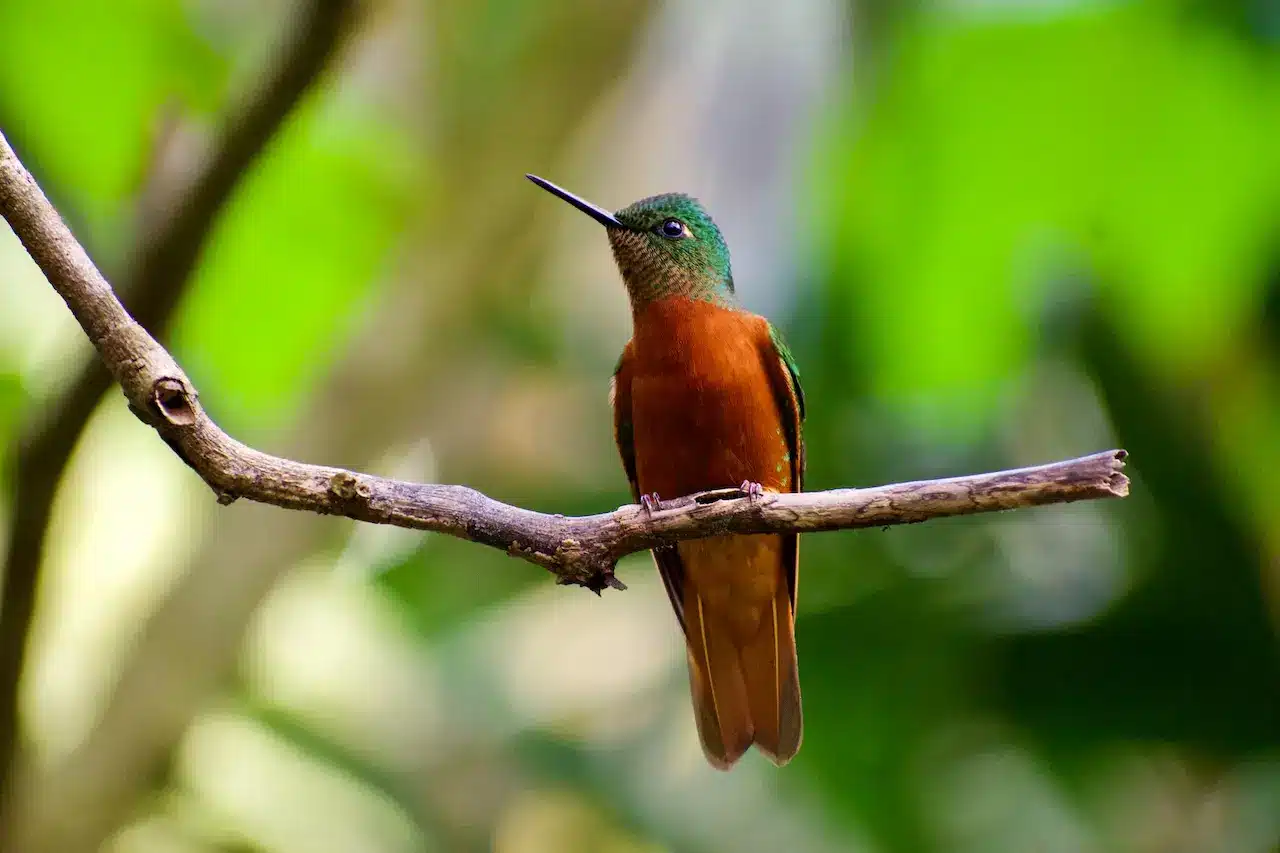
Both males and females share a shimmering iridescent green coloration on their upperparts, which appears especially bright under direct sunlight. Their bills are long, straight, and slender, colored dull black, perfectly suited to probe deep into flowers. Their eyes, legs, and feet are dark brown to black, providing a subtle contrast against their vivid plumage.
The adult male is particularly notable for its spectacular iridescent violet to purple crown and gorget (throat patch). In varying light conditions, these areas can appear velvety black or brilliantly shimmering purple. The gorget feathers extend into elongated side plumes that project sideways, giving the appearance of a striking “moustache” or whiskers, a feature unique to this species. The male’s back is metallic green, while the underparts are mostly white with greenish flanks. His tail and wings are relatively short and black, completing his compact and dazzling appearance.
In contrast, the adult female lacks the flashy violet crown and throat patch. Instead, her crown and back are a muted greyish-green, blending well into the desert environment. Her throat and underparts are mostly white, although mature females may display a few scattered purple or dark feathers on the throat. Her flanks have a buffy or pale cinnamon tint, and her tail feathers are dark with white tips on the outermost feathers. These subtler markings aid in camouflage and protection from predators.
Juvenile Costa’s hummingbirds resemble adult females but can be distinguished by their slightly duller and greyer upperparts, with some grey-buff edging to their feathers. Their tails are more rounded than adults, and they develop full adult plumage by about one year of age.
Behavior & Diet
Costa’s hummingbirds are highly active and territorial birds, especially the males during the breeding season. They perform rapid, darting flights and are capable of hovering in place while feeding or displaying. Their wings beat at an incredible rate of approximately 50 to 60 times per second, generating the characteristic humming sound that gives the family its name.
Their diet consists mainly of nectar from a variety of desert-adapted flowering plants. They have a particular affinity for tubular flowers such as those from the chuparosa (Justicia californica), ocotillo (Fouquieria splendens), and desert honeysuckle (Anisacanthus thurberi). Nectar provides essential sugars for their high metabolism and energetic lifestyle. To supplement their diet, Costa’s hummingbirds also consume small insects and spiders, which supply vital proteins and nutrients. These insects are often caught mid-air or gleaned from flower blossoms and foliage. According to Cornell Lab of Ornithology, this species is well documented.
Males are notably territorial and vigorously defend their feeding territories against rivals and even larger hummingbird species. They perform elaborate aerial displays to ward off intruders and attract females. Outside the breeding season, they may tolerate other individuals more readily, especially around abundant food sources. According to RSPB, this species is well documented.
Breeding & Reproduction
The breeding season for Costa’s hummingbirds typically occurs from late winter through early summer, depending on geographic location and availability of resources. Males begin courtship by performing spectacular aerial displays, including rapid dives and figure-eight flight patterns, showcasing their iridescent gorgets and elongated throat feathers to potential mates.
Females build small, cup-shaped nests constructed primarily from plant down, spider silk, and other soft materials, often camouflaged with lichens and bark. These nests are usually placed on small branches or desert shrubs at heights ranging from 1 to 3 meters (3 to 10 feet) above the ground. The female alone incubates the eggs and cares for the young.
A typical clutch consists of two tiny, white eggs, each about the size of a jellybean. Incubation lasts approximately 14 to 16 days, after which the hatchlings are altricial—born naked and helpless. The female feeds the nestlings a nutrient-rich mixture of regurgitated nectar and insects until they fledge at around 20 to 22 days old. Juveniles gain independence gradually but generally remain close to suitable feeding areas.
Conservation Status
According to the International Union for Conservation of Nature (IUCN), Costa’s hummingbirds are currently classified as Least Concern. Their populations are considered stable, and they benefit from their adaptability to arid habitats and a wide range of nectar sources. However, like many desert species, they face potential threats from habitat loss due to urban development, agriculture, and climate change, which can reduce the availability of flowering plants and nesting sites.
Conservation efforts focus on preserving native desert vegetation and promoting sustainable land-use practices. Providing nectar-rich plants in gardens and urban areas can also support local populations. Birdwatchers and photographers play a valuable role in monitoring these hummingbirds and raising awareness about the importance of desert ecosystems.
Interesting Facts
Costa’s hummingbirds are remarkable for several unique adaptations. Their elongated throat feathers in males are not only visually striking but also play a role in courtship, producing subtle sounds during aerial displays. These “moustache” feathers can reflect ultraviolet light, invisible to the human eye but highly conspicuous to other hummingbirds.
Despite their small size, Costa’s hummingbirds are capable of long-distance movements and have been recorded at elevations ranging from sea level up to 1,500 meters (about 5,000 feet). Their rapid metabolism is supported by frequent feeding; they visit hundreds of flowers daily to meet their energy demands.
They are often confused with the similar Black-chinned hummingbird (Archilochus alexandri), especially females. However, males are distinguishable by the Costa’s hummingbird’s vibrant purple gorget and elongated side plumes, whereas Black-chinned males have a mostly black gorget with a violet band. Vocalizations also differ between species, aiding identification in the field.
In addition to their ecological importance as pollinators, Costa’s hummingbirds serve as an inspiration for wildlife photographers due to their brilliant colors and dynamic flight. Their presence signals a healthy desert ecosystem and highlights the richness of life in seemingly harsh environments.
In summary, Costa’s hummingbirds are a spectacular example of nature’s artistry and adaptation. Their diminutive size, brilliant coloration, and fascinating behaviors make them a cherished species for anyone interested in the birds of the American Southwest and northwestern Mexico. Whether spotted flitting among desert blooms or performing aerial courtship displays, these hummingbirds continue to enchant and educate all who observe them.