
Many people are enamoured with the idea of keeping a pet butterfly… and with good reason!
Observing the slow, gradual, complex change from egg, to larva, to pupa and finally emergence as an adult is one of the most miraculous wonders of nature we are gifted to behold.
The butterfly life cycle is a perfect example of the complete insect metamorphosis – with an egg, larva (caterpillar), pupa (chrysalis) and the adult butterfly.
Nevertheless, you should bear in mind that butterflies are not the traditional sort of pet. In general they have a very short lifecycle, only 2-3 weeks on average. So once they eventually emerge from their pupa, you will gain much more pleasure (for yourself and your pet butterfly), if you release them shortly after they emerge. The alternative is keeping them (unable to fly any meaningful distance and express their natural instincts) subdued cruelly in captivity for the duration of their short lives.
The larva however are slow moving and have no wings… so will be perfectly comfortable in your cage, whilst they safely fatten themselves up and grow!
The Nettle Eaters
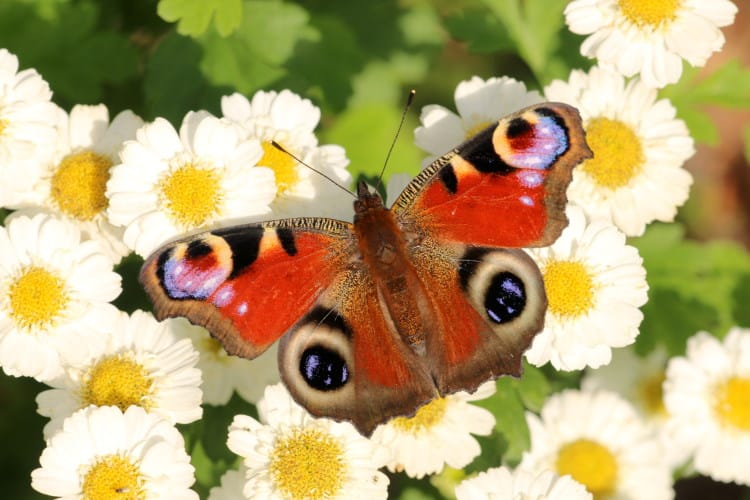
Pet Butterflies are fun to raise and if you go about it properly, it is not to difficult. 4 species for whom the rearing methods are very similar are, the Peacock (Inachis io) the Red Admiral (Vanessa atalanta) the Small Tortoiseshell (Aglais urticae) and the Comma (Polygonia c-album).
All of these are common spring or early summer butterflies and have larvae that feed on Stinging Nettles (Urtica dioica). They all hibernate as adults over winter, though the coma is restricted to the South and Red Admirals who rarely survive the winter; though some do in Devon and Cornwall at least, and they arrive regularly from the continent every Spring.
Before you go looking for butterflies though you will have to get your cage and food plants sorted. The most satisfying way to raise the caterpillars is from eggs you have watched being laid on live plants. For this you will need several large plant pots (about 25-35 cms across) and a healthy collection of Nettle (Urtica dioica) roots or plants cut off near the ground.
Fill the pots to within about 10 cm from the top with topsoil and/or compost, plant the nettles on this and fill the pot to about 2-3 cm from the top. You will also need 5 x 120 cm Bamboo canes per pot; these should be pushed into the soil right to the bottom of the pot, and evenly spaced around the edge of the pot. Leave these outside, covered with a sack until next Spring. They should start growing then and may need watering occasionally, as the soil in the pots will dry out faster than the soil in the ground.
You will also need about 0.5 of a metre of fine black mesh, this can be bought from Watkins and Doncaster, Maris House Nets and a number of Butterfly Houses. In the Spring, wrap the mesh around the outside of the poles; tie firmly at the top and hold the bottom of it to the top of the pot with some elastic, this will allow you access.
You can buy pet butterfly eggs from a number of Butterfly Houses; you will have to do a Google search, as I do not know them all, if you want to buy some. The nicest way is to either find your own eggs in the wild and transfer the caterpillars after they hatch; or to catch some butterflies and keep them under the mesh until they mate and lay eggs.
Note that though both sexes look the same, the males will be the ones holding territories and flying up to investigate everyone. The females will be not holding a territory, though for the first couple of weeks they will be all looking for food. You will have to feed your pet Butterflies an artificial nectar, a 10% mixture of honey in water will do. You can give this to the Butterflies by soaking a piece of cotton wool in it and placing it on the top of the mesh.
As this dries out, do not just rewet it because the water dries out and the honey doesn’t. If you just rewet it, it will get more and more concentrated, becoming harder for the butterflies to sip and likely to cause digestive problems. It may even crystallise in their proboscis preventing further feeding. It is best to simply replace it at least everyday.
They all will only lay in bright sunshine, and they all take several weeks to reach sexual maturity. If you are lucky you will see both the mating and the egg laying; you can then let the pet Butterflies out again.
If you have bought or collected eggs you will need to keep them in a small container with as little vegetation as possible; if you open the container once a day and breath on them a few times this will keep them humid. When they hatch, transfer them very carefully to the Nettles with a fine paint brush. Where about you put them on the plant will depend on the species (see notes below).
The Small Tortoiseshell (Aglais urticae)
Lays the eggs in clumps on the underside of the leaf and take about 10 days to hatch. When they hatch, the larvae go straight to the top of the Nettle plant where they live together in a silk web until they reach their third instar. Then they tend to become solitary, rolling up one or two leaves to live in they – take about a month to grow to full size. They will pupate at the top of the mesh and emerge about 14 days later.
The Peacock (Inachis io)
Lays the eggs in clumps on the underside of the leaf and take about 14 days to hatch. When they hatch, the larvae live together in a silk web until they reach their third instar. Then they tend to become solitary, rolling up one or two leaves to live in; they take about a month to grow to full size. They will pupate at the top of the mesh and emerge about 14 days later, in late May to early June with a second brood in late July.
The Red Admiral (Vanessa atalanta)
Lays eggs singly on the topside of the leaf; when it hatches the larva it roles up a leaf to live in, making a new one when this is eaten out. They take about one month to grow to maturity and be ready to pupate.
It is a good idea to release your pet Butterflies close to where you found their parents.
The Early Browns
In Britain we have 11 butterflies known as ‘Browns’; they are all members of the family ‘Satyridae’ and are divided between 7 genera. Most of them are relatively common, they all feed on grasses as larvae and all have their pupae hanging down, or free on the ground.
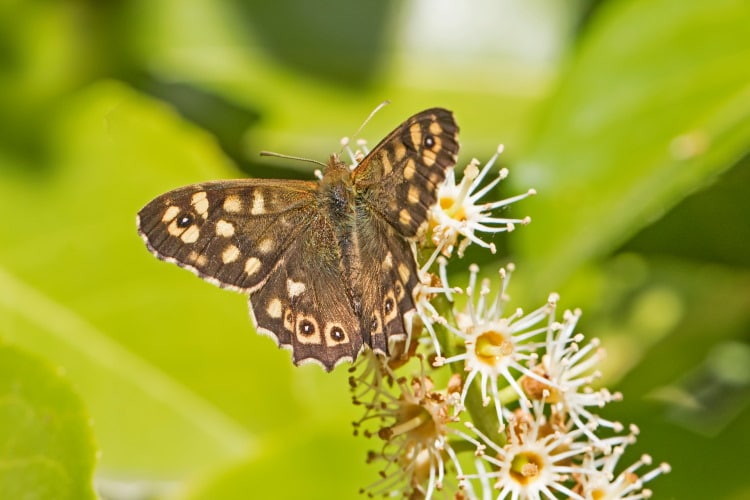
Here I am going to talk about 3 of them; the ‘Speckled Wood’ (Parage aegeria) which is easy and fun to raise; the ‘Wall’ (Lasiomata megera), which is probably not much harder once you have caught a female; and the ‘Ringlet’ (Aphantopus hyperantus), which is slightly harder because it takes a whole year for one generation and because it over-winters as a larvae.
Whichever ones you decide to rear, you will need both food plants and a cage. The food plants should be alive and growing in pots, and should be a grass. ‘Cocksfoot’ (Dactylis glomerata) makes an excellent food plant for all 3 species, though you can use nearly any other grass. I have known people raise both the Wall and the Speckled Wood on young Maize plants and on ordinary lawn grass that has been potted up and left to grow (it needs to be at least 15 cms high).
The best sort of cage is one about 40 cm high by 50 cm by 30 cm; it should have a solid wooden floor and mesh sides and top. You will have to feed your pet Butterflies an artificial nectar, a 10% mixture of honey in water will do (see notes above in the first section)
The Speckled Wood (Parage aegeria)
As its name implies, The Speckled Wood is a Butterfly of woodland edges and can most easily be found on paths that run along the edge of a wood, or by walking down rides and bridle ways through woods. The female is slightly larger and has larger spots than the male. However, telling them apart in the field is not easy for the beginner and you would probably do as well as to catch half a dozen and then set free those that are obviously not laying eggs; you probably do not want to raise more than a dozen or so at a time anyway.
The Speckled Wood is unique among British butterflies in that it can over-winter as either a pupae or a larvae. Those that overwinter as pupae emerge in March; and those that over-winter as a larvae feed first then pupate and emerge in late April May. As there are normally at least two broods a year, this staggering insect life cycle means you can find adults from March till September – even though they only live for two to three weeks. Females will lay eggs about one week after emergence.
The eggs are laid singly on the grass stem or blade; they take about a week to hatch and are white with a black head at first, but soon turn green (and are very hard to see on the grass). Look for the small crescents in the grass blades that will tell you where they have been feeding. After about 4 – 5 weeks they will pupate low down in the grass tussock; the pupae is green at first but becomes a rusty colour after 10 days. The new butterflies should emerge in a further 3 -4 weeks. The cage should be kept in the sunshine.
The Wall (Lasiomata megera)
The life cycle of the Wall Butterfly is very similar to the Speckled wood, except that they only overwinter as a larvae. The larvae are nocturnal (hence they only feed at night) but the adults prefer slightly sunnier places and are often found near the coast. I have often had males fly up and along the path before as I walk along coastal footpaths that have hedgerows alongside.
The eggs are laid singly on the grass stem or blade; they take about 10 days to hatch. They feed on the same grasses as the Speckled Wood and the instructions for starting a culture are the same. The larvae take about 35 days to reach maturity and then pupate low down in the grass tussock. The pupae take about two weeks before emergence. In the wild there are normally two, sometimes three generations a year; the first pupate in the early spring (from the first week in April to early May) and the eggs are laid in late spring (mid May to June); the second normally emerge in late July or early August. The cage should be kept in the sunshine.
The Ringlet (Aphantopus hyperanthus)
The Ringlet prefers damper and shadier places to either of the above two; it is as likely to be found flying in the dappled shadows of fairly open Woods along the edges. Though it feeds on the same grasses as the above two, it is probably best to raise them separately because of the longer (one generation a year) lifecycle.
The best way to start a culture is again to catch some females and let them lay in the cage; the adults are on the wing in June and July and they live four 4 -5 weeks. The females will not stick their eggs to the grass, as do the other two species, but instead just drop them as they are flying about. Some will land in your pots of grass, but others will land on the floor of the cage; you will have to pick these up gently and drop them gently into the grass pots.
They will hatch 20 days later and grow slowly; they over-winter as larvae and will feed all through the winter on warmer sunnier days. The cage needs to be kept in a shady but light spot. Again, unlike the above two and during the winter, you will need to put the cage in a frost free but light environment (like a cool green house); but do remember to put it outside again in the spring. They will pupate in late April to May.
It is a good idea to release your Butterflies close to where you found their parents.
The Cabbage Eaters
The Large White Pieris brassicae is often erroneously referred to as the Cabbage White; and the Small White Pieris rapae are often cursed by gardeners – and generally reguarded as a pest. However, because of this they make a good pair of pet butterflies for the complete novice to start with and gain some competence with, before moving on to other less easy species.
The other 2 cabbage eaters are the Green-veined White Pieris napi and the Orange Tip Anthocharis cardamines. Both prefer wild members of the cabbage family over cultivated varieties and therefore are not a nuisance to gardeners; and for this reason you may feel happier breeding them. These four butterflies are all members of the family Pieridae and are commonly called ‘Whites’. We do have other members of the Pieridae in Britain, but they do not feed on cabbages.
Whichever ones you decide to rear, you will need both food plants and a cage. The food plants should be alive and growing in pots. The best sort of cage is one about 40 cm high by 50 cm by 30 cm, it should have a solid wooden floor and mesh sides and top. You will have to feed your pet Butterfly an artificial nectar, a 10% mixture of honey in water will do (again refer to notes at top).
All Pierids stand upright in their pupae and are supported around their middle by a girdle of silk.
Large White (Pieris brassicae)
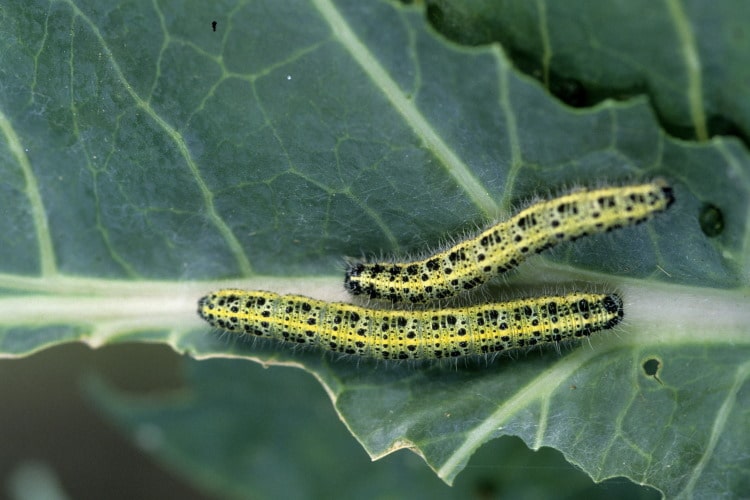
In the wild, Large White Buttergy emerge in late April early May, depending on the weather. The female has dark spots and a short dark bar on the forewing which allows her to be easily distinguished from the male. The eggs are laid in batches of from 3-4 to over 100, on the underside of the leaves. The caterpillars, which are a sort of greeny-yellow with black speckles and marks, hatch in about 1 week.
For the first 2 instars they live communally, but after this they spread out and feed singly. It takes them about 4 weeks to reach full size; whereupon they pupate, generally on the sides of buildings or other upright flatish surfaces. The adults emerge after about 2 weeks and seek nectar for a short while, before mating and laying a second generation. This second generation is on the wing by September; in some years there may be a third brood which pupates in late October. Large Whites can be fed on any commonly cultivated cabbage.
The Small White (Pieris rapae)
The Small White Butterfly has a very similar lifecycle to the Large White, with the following differences; the eggs are laid singly and the caterpillars are nearly all green and feed singly. The caterpillars tend to burrow into the heart of the cabbage when feeding; the Large White caterpillars feed on the outer leaves. The first generation pupates on the cabbage plant, but the second pupates on walls like its larger cousin. You will find it easiest if you use small hearting cabbages.
The Green-veined White (Pieris napi)
The Green-veined White prefers damper shaded habitats, such as woodland rides and hedgerows to gardens. The female lays her eggs singly on the undersides of the leaves of native members of the cabbage family such Cuckoo Flower, Charlock and Garlic Mustard. However, in captivity it is probably just as easy to rear it on Horseradish. The life cycle is again similar to the Small White, as is the colouration of the caterpillars.
The Orange-Tip (Anthocharis cardamines)
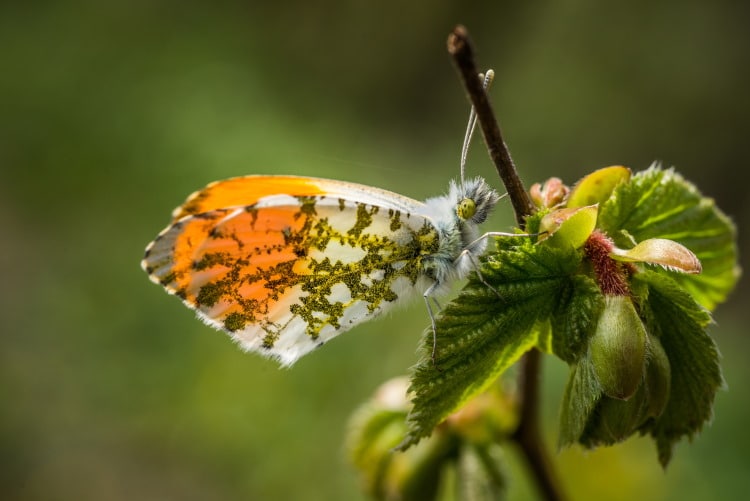
The Orange Tip Butterfly likes similar situations to, and uses similar plants as, the Green-veined White; except that the eggs are laid near the top of the plant just under the flower heads (they are green at first but soon turn bright orange).
The caterpillars feed first on the flowers and then on the developing seed pods. They feed singly, one per plant, and are carnivorous of any other caterpillar on their plant. For this reason, you have to make sure that each plant only has one caterpillar to it. If the plants are tall and branch near the bottom, you can have one on each stem providing there are enough flower heads available. They have only one generation per year; once the larvae have pupated, the pupae should be collected up and stored in a frost-free place such as a old wooden shed. This also applies to the last pupae of the other three Cabbage Eaters – all of which over-winter as pupae.
Next spring the pupae can be brought out and allowed to emerge naturally. It is always a good idea to release your pet Butterflies close to where you found their parents.
Final Thoughts
Well, I hope this article is useful to you in your pursuit of the joy of observing and raising butterflies as (temporary) pets. If you would like more knowledge around this subject, please check out our Lepidoptera page.


Hello Gordan,
My Peacock Butterfly has lived in my medieval cottage all winter. But as I was fearful of sucking it up in the vacuum cleaner I eventually put it in a large plastic old fashioned ‘sweetie’ jar. We are still getting frosts here in Surrey UK so I am frighted to set it free outside. Should I feed it? When I put the jar in the in the warm sunshine it flaps its wings energetically. It always sleeps on the black lid inside the jar. It seems quite happy and I would like to save it from dying. Can you advise me? I get them every year!
Hi Pam, if you want to feed it use diluted honey water. Jus off it in a bottle cap, if the butterfly wants it it will take it. However mid-March would be the time for the first spring emergence of hibernating Peacocks so you might want to put it somewhere where it can escape if it wants.