
Bird Respiration; The Breath of Flight
Bird respiration, the breathing sort of respiration, is far more complex in birds than in mammals.
Like us birds have lungs, and like us, they need to breathe air in and out of their lungs. This is to fulfill the cycle of bringing oxygen into the body – to be used in metabolism – and also to take the waste CO2 away from the body.
Bird respiration, or breathing begins when air is breathed in through a bird’s two nostrils, situated at the base of the bill (except in Kiwis where they are at the tip of the bill and gannets – where nostrils have become redundant and breathing is through the mouth).
However, unlike us, when a bird breathes – the air does not go simply in and out of the lungs in a simple “U-shaped” path. Instead birds have a number of large extensions called ‘air sacs’ and hollow (pneumatized) bones, all interconnected to their lungs.
These allow the air to flow around in a grand circle, meaning birds can have fresh, oxygen-rich air in their lungs all the time.
The Mechanics of Bird Respiration
Also, unlike us mammals, a bird’s breathing is not driven into and out of the lungs using a diaphragm. In birds, breathing is controlled by muscular contractions of the ribcage, which reduce or increase the overall size of the body cavity and thus force air out of the various air sacs.
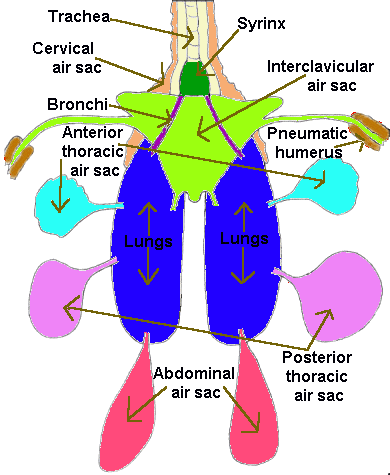
This air enters the ‘trachea’, then passes down the throat until it reaches the syrinx (a bird’s vocal cords). Here the trachea divides into two ‘bronchi’, before passing through the bird’s lungs. This freshly inhaled air goes first, not to the lungs, but to the abdominal air sacs. These are the largest and most important of a bird’s air sacs.
Some of this inhaled air goes to the posterior air sacs also.
When the bird breathes out, this air moves from these air sacs into the lungs. When the bird breathes in again, this air moves from the lungs to the interclavicular, thoracic, and anterior air sacs. When the bird breathes out a second time, the air passes up the bronchus and out of the bird’s system.
Thus it takes two breaths – and not one – for air to pass in and out of a bird’s respiratory system.
Also important to note is the fact that air passes right through the bird’s lungs. This allows for an almost continuous flow of air over the ‘alveoli’ and for a greater exchange rate in gases.
This exchange rate is also enhanced by the fact that bird alveoli are 10 to 100 times smaller than ours, giving a far greater surface area per volume for gaseous exchange to take place.
Respiration Rates in Birds
How fast birds breathe is roughly correlated with their body mass, with smaller birds breathing more rapidly than larger ones (See Calder 1968 for information on resting breath rate.). For example, an Ostrich (Struthio camelus) weighing 90 to 100 kg has a resting breath rate of 5 to 6 breaths per minute. The comparable value for an Orange-cheeked Waxbill (Estrilda melpoda) with a weight of just 6.9 grams is 113 breaths per minute. Intermediate to this a 658-gram Buzzard (Buteo buteo) has a breath rate of around 18 breaths per minute and a 92-gram Song Thrush (Turdus merula) has a breath rate of around 48 breaths per minute.
Flight is energetically expensive, and so birds need a lot of oxygen to keep their large flight muscles working. Berger Hart and Roy 1969 showed that for three species of common birds, the in-flight breath rate was ten times their resting breath rate.
How much do you know about how a bird flies?


Can one see a bird’s breath in bitter cold? I have not ever seen that.
I have not seen it either, but that does not prove anything.
Yes. Google “photo of red-winged blackbird in the cold” – there are several photos that are masterpieces!
Thanks Patricia.